What Is Light? Waves, Particles and Colour
Is light a wave or a particle? Explore how scientists from Newton to Einstein worked it out, why we see colour, and how to split light into a spectrum at home.
Light is the fastest thing in the universe and the reason you can read these words. It warms your skin, powers almost every food chain on Earth and carries news from galaxies so distant that the light set out before Earth existed. Yet for most of history, nobody could say what light actually is.
The answer turned out to be one of the strangest in all of science. Light behaves like a wave when it spreads and overlaps, and like a stream of particles when it is absorbed. Working that out took the combined efforts of Isaac Newton, Thomas Young, James Clerk Maxwell, Albert Einstein and many others.
In this article you will follow that story, find out how fast light travels and why it slows down in glass, learn how your eyes turn a narrow band of radiation into the full palette of colour, and try a simple way to split light at home.
The fastest thing there is
In empty space, light travels at exactly 299,792,458 metres per second, close to 300,000 kilometres every second. That figure is exact because, since 1983, the metre itself has been defined by it: one metre is the distance light travels in a vacuum in 1/299,792,458 of a second.
At that speed, light could circle Earth about seven and a half times in a single second. Sunlight takes roughly eight minutes and twenty seconds to reach us, so when you look at the Sun (never directly, and never through binoculars or a telescope), you are seeing it as it was over eight minutes ago. Light from the nearest star beyond the Sun takes more than four years.
Light slows down when it passes through transparent materials. In water it travels at about three-quarters of its vacuum speed; in ordinary glass, about two-thirds. That slowing is what makes light bend, or refract, when it enters a new material at an angle. Refraction is why lenses focus, why a straw looks broken in a glass of water and why raindrops can produce rainbows.
Particles or waves? A three-hundred-year argument
Newton's corpuscles
In the 1660s, Isaac Newton passed sunlight through a glass prism and showed that white light is a mixture of colours, and that a second prism could recombine them into white. He favoured the idea that light was made of tiny particles, which he called corpuscles, travelling in straight lines. His reputation gave the particle view great weight for more than a century.
His contemporary Christiaan Huygens argued instead that light was a wave, spreading out like ripples on a pond. Both pictures could explain reflection and refraction, so the debate stayed open.
Young's two slits
Around 1801 to 1803, the English scientist Thomas Young performed experiments that seemed to settle the matter. When light passes through two narrow, closely spaced slits, it does not simply make two bright lines on a screen. It makes a pattern of many bright and dark bands.
Waves explain this neatly. Where crests from the two slits meet crests, they add up and make a bright band; where crests meet troughs, they cancel and leave darkness. This adding and cancelling is called interference, and particles, as people then understood them, could not do it.
Maxwell's electromagnetic waves
In the 1860s, James Clerk Maxwell brought electricity and magnetism together in a single set of equations. They predicted waves of linked electric and magnetic fields that would travel at a speed matching the measured speed of light. Maxwell concluded that light is an electromagnetic wave. In the late 1880s, Heinrich Hertz generated and detected invisible electromagnetic waves (what we now call radio waves) in his laboratory, confirming that Maxwell's waves were real.
The wave theory looked complete. Then a small puzzle broke it open.
Einstein's photons
When light shines on certain metals, it knocks electrons out of the surface, an effect called the photoelectric effect. Experiments showed something the wave theory could not explain: dim blue or ultraviolet light could eject electrons, but bright red light, however intense, could not.
In 1905, Albert Einstein proposed that light arrives in separate packets of energy, later named photons. The energy of each photon depends on the light's frequency: blue and ultraviolet photons each carry more energy than red ones. A single high-energy photon can knock out an electron; no number of low-energy red photons can, because each one individually falls short. Einstein received the Nobel Prize in Physics for 1921 "especially for his discovery of the law of the photoelectric effect", not, as many people assume, for relativity.
Both at once
So which is it? Modern physics says light is neither an ordinary wave nor an ordinary particle. It is a quantum object that shows wave-like behaviour when it travels and interferes, and particle-like behaviour when it is emitted or absorbed. Remarkably, Young's two-slit pattern still appears even when light is sent through the apparatus one photon at a time: each photon lands at a single spot, yet over thousands of arrivals the familiar bands build up. This wave–particle duality is now known to apply to electrons and atoms as well.
The electromagnetic spectrum: light we cannot see
Visible light is just a narrow slice of a vast family of electromagnetic waves that differ only in wavelength (and therefore frequency and photon energy).
| Type of radiation | Typical wavelength | Where you meet it |
|---|---|---|
| Radio waves | Centimetres to kilometres | Broadcasting, Wi-Fi, mobile phones |
| Microwaves | Millimetres to centimetres | Microwave ovens, radar |
| Infrared | About 700 nanometres to 1 millimetre | Heat from warm objects, TV remotes |
| Visible light | About 380 to 700 nanometres | Everything you see |
| Ultraviolet | About 10 to 380 nanometres | Causes sunburn; makes some materials fluoresce |
| X-rays | Fractions of a nanometre | Medical and dental imaging |
| Gamma rays | Smaller still | Radioactive decay, some astronomical sources |
All of these travel at the same speed in a vacuum. Telescopes tuned to different parts of the spectrum reveal different things: cool dust glows in infrared, while hot, violent regions shine in X-rays. Our article on the history of the telescope shows how astronomers expanded beyond visible light.
How we see colour
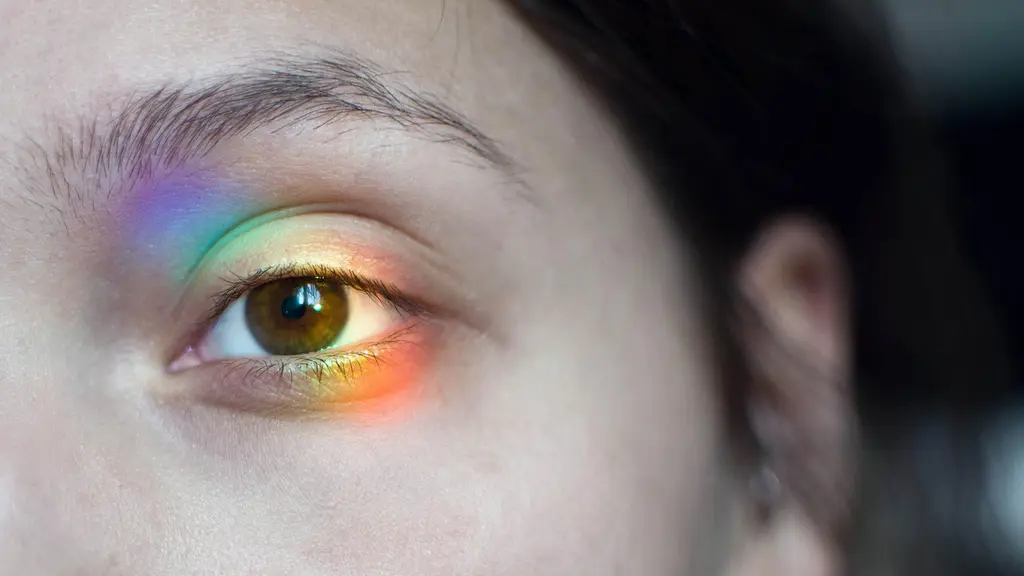
Within the visible band, our brains interpret different wavelengths as different colours, running from violet at the short end, through blue, green, yellow and orange, to red at the long end.
The retina at the back of the eye contains three types of cone cells, each most sensitive to a different range of wavelengths, loosely described as short (blue), medium (green) and long (red). Every colour you perceive comes from the brain comparing how strongly each type of cone responds. Yellow light stimulates the medium and long cones together; so does a mixture of pure red and pure green light. That is why a screen made only of tiny red, green and blue dots can display yellow, and millions of other colours.
Mixing light versus mixing paint
| Mixing light (additive) | Mixing paint or ink (subtractive) | |
|---|---|---|
| Primary colours | Red, green, blue | Cyan, magenta, yellow |
| Mix all primaries | White | Close to black |
| Where it is used | Screens, stage lighting | Printing, painting |
The difference comes from what happens to the light. Screens add light together. Paints and inks absorb (subtract) some wavelengths from white light and reflect the rest. A red apple looks red because its skin absorbs most of the other wavelengths and reflects mainly red. The molecules responsible for that absorption are explored in our companion article on the chemistry of colour. Scattering adds another twist: tiny gas molecules in the air scatter blue light more than red, which is why the sky is blue.
Try this: make a spectrum at home
Water prism. On a sunny morning, fill a clear glass to the brim with water and stand it on a windowsill in direct sunlight, with a sheet of white paper on the floor or a table below. Move the paper around until a small band of colours appears. Which colour is bent the most?
CD spectroscope. Hold an old CD or DVD so that light from a lamp or a bright window reflects off the shiny underside, and tilt it slowly. The fine, closely spaced tracks act as a diffraction grating, splitting light into its colours by interference. Compare a white LED bulb, an old-style filament bulb and daylight: are the spectra the same?
Safety: Never look directly at the Sun, even briefly, and never look at it through a CD, lens, binoculars or telescope; this can permanently damage your eyes. Point the CD at a lamp or a bright patch of sky away from the Sun. Do not shine laser pointers at anyone's eyes, and keep them away from young children.
What light has given us
Understanding light has changed the world many times over. Einstein's photon idea underpins solar panels, which use photons to free electrons and generate current (see how solar panels turn light into electricity). Lasers, built on the quantum behaviour of light and atoms, now carry most of the world's internet traffic through glass fibres, a story told in our archive article on lasers and optical fibre.
Key ideas to remember:
- Light travels at 299,792,458 metres per second in a vacuum and slows down in materials such as water and glass, which makes it bend.
- Light is an electromagnetic wave, and it also comes in packets of energy called photons; it shows both behaviours.
- Visible light is a tiny part of the electromagnetic spectrum, which runs from radio waves to gamma rays.
- We see colour because three types of cone cell respond differently to different wavelengths.
Something to wonder about: if you could ride alongside a beam of light, what would you see? Einstein asked himself that question as a teenager, and it eventually led him to the theory of relativity.
Sources and further reading
- Tour of the Electromagnetic Spectrum, NASA Science
- Speed of light in vacuum (CODATA value), NIST Physical Measurement Laboratory
- Albert Einstein: Facts (Nobel Prize in Physics 1921), The Nobel Prize
- Light, Encyclopaedia Britannica
- HyperPhysics: Light and Vision, Georgia State University, Department of Physics and Astronomy