From the archive
Light Through Glass: How Lasers and Optical Fiber Rewired Communication
From Einstein's stimulated emission to Kao's clear-glass prediction, how quantum physics and materials science built the fiber-optic backbone of the internet.
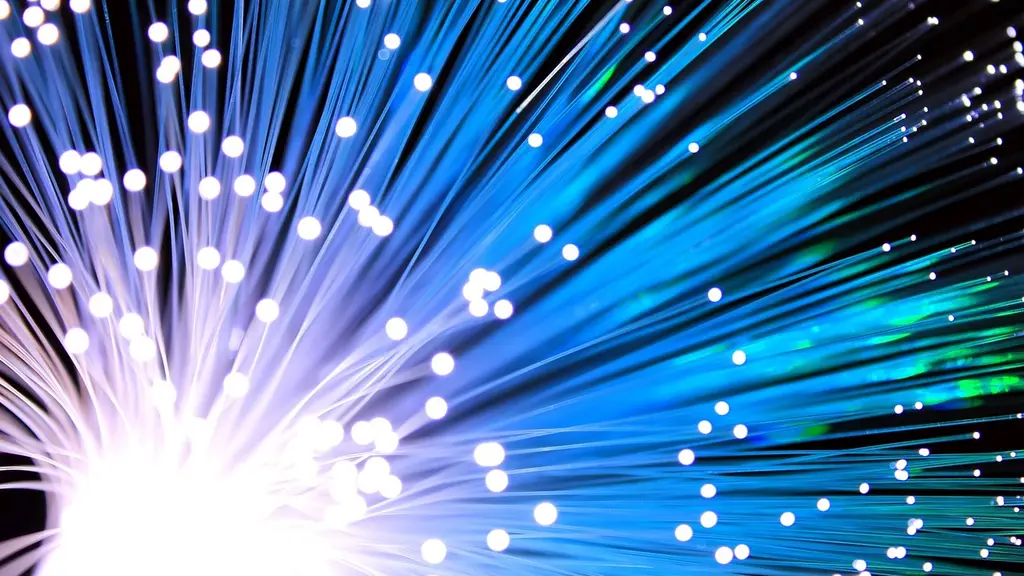
When you stream a video, send a photo or join a video call, the data almost certainly spends part of its journey as flashes of infrared light inside a strand of glass thinner than a human hair. Those strands run under streets, along railway lines and across ocean floors, and the flashes are produced by lasers smaller than a grain of salt.
Neither the laser nor the ultra-clear glass fiber was invented with the internet in mind. The laser grew out of a question about how atoms absorb and give off light, first asked by Albert Einstein during the First World War. The fiber grew out of patient work on why glass absorbs light at all. This article follows both threads and shows how they came together.
Why light beats electricity for carrying information
Copper telephone wires carry information as electrical signals, and they have two problems over long distances: the signal fades quickly, and there is a limit to how fast it can be switched on and off. Light has a much higher frequency than radio or electrical signals, roughly hundreds of trillions of oscillations per second for the infrared used in fibers, so in principle it can carry vastly more information.
The catch was practical. Ordinary light sources, such as light bulbs, produce a jumble of colors traveling in every direction, which is useless for precise signaling. And sending light through the open air is defeated by fog, rain and anything that gets in the way. Two inventions were needed: a clean, controllable light source and a clear "pipe" to guide it.
The physics that made lasers possible
The story starts with quantum theory:
- 1900: Max Planck proposed that light energy is emitted in discrete packets, or quanta.
- 1905: Einstein used the idea to explain the photoelectric effect, treating light itself as particles (photons). This earned him the 1921 Nobel Prize in Physics.
- 1913: Niels Bohr described atoms whose electrons can sit only at certain energy levels, jumping between them by absorbing or emitting photons of exactly the right energy. (Our explainer on the changing picture of the atom covers this step in more detail.)
- 1916–17: Einstein worked out that, besides absorbing and spontaneously emitting light, an excited atom can be stimulated to emit by a passing photon. The new photon is a perfect copy of the first: the same energy, direction and phase.
For decades, stimulated emission was a theoretical curiosity. In normal matter, most atoms sit in their lowest energy state, so light is absorbed far more often than it is amplified. The trick, physicists later realized, was to create a "population inversion," with more atoms excited than not, so that one photon triggers a cascade of identical copies.
At Columbia University in the early 1950s, Charles Townes, working with James Gordon and Herbert Zeiger, achieved this with ammonia molecules and microwaves, building the first maser (microwave amplification by stimulated emission of radiation) in 1954. Townes shared the 1964 Nobel Prize in Physics with Nikolay Basov and Aleksandr Prokhorov in Moscow, who had developed related ideas independently.
In 1958 Townes and Arthur Schawlow of Bell Labs published a proposal for an "optical maser," using mirrors at each end of the material to bounce light back and forth and build up the cascade. On May 16, 1960, Theodore Maiman at Hughes Research Laboratories made it work, flashing a bright lamp around a rod of synthetic ruby to produce the first laser pulses of deep red light. Later that year, Ali Javan and colleagues at Bell Labs built a helium-neon gas laser that shone continuously.
What makes laser light special? Because every photon is a copy of the one that triggered it, laser light is a single, pure color, travels in a tight beam and has its waves marching in step. That makes it ideal for switching on and off billions of times a second and for coupling into a tiny glass core.
Shrinking the laser onto a chip
Ruby and gas lasers were far too bulky and power-hungry for telephone networks. The solution came from semiconductor physics. In 1962, teams at General Electric, IBM and MIT's Lincoln Laboratory independently showed that a junction in gallium arsenide could lase when current flowed through it. But those early diode lasers worked only in short pulses and usually had to be cooled to very low temperatures.
The fix was to sandwich a very thin active layer between layers of a slightly different semiconductor, a heterostructure, which traps both electrons and light in the middle. Herbert Kroemer in the United States and Zhores Alferov in the Soviet Union proposed versions of this idea in 1963. In 1970, Alferov's group in Leningrad and Izuo Hayashi and Morton Panish at Bell Labs achieved continuous operation at room temperature. Alferov and Kroemer shared half of the 2000 Nobel Prize in Physics for semiconductor heterostructures. The same principles are used in the diode lasers that drive today's fiber links.
The race for clearer glass
Glass looks transparent, but in the 1960s even the best optical glass absorbed so much light that a signal faded to almost nothing within a few meters, a loss of around 1,000 decibels per kilometer. Most engineers considered glass fibers hopeless for long-distance communication.
In 1966, Charles Kao and George Hockham at Standard Telecommunication Laboratories in England argued otherwise. Their analysis showed that the losses were not built into glass itself but came mostly from impurities such as traces of iron and copper. If those could be removed, they calculated, losses could fall below 20 decibels per kilometer, good enough for practical communication links. Kao spent years promoting the idea and testing materials. He received half of the 2009 Nobel Prize in Physics for this work.
The challenge was taken up at Corning Glass Works in New York. In 1970, Robert Maurer, Donald Keck and Peter Schultz made a fiber from extremely pure fused silica, and Keck measured a loss of about 17 decibels per kilometer, beating Kao's target.
What does "decibels per kilometer" mean?
Decibels measure ratios. Every 10 dB of loss cuts the light by a factor of ten.
| Fiber loss | Light left after 1 km | Light left after 100 km |
|---|---|---|
| 1,000 dB/km (1960s glass) | essentially none | none |
| 20 dB/km (Kao's target) | 1% | none detectable |
| 17 dB/km (Corning, 1970) | about 2% | none detectable |
| about 0.2 dB/km (modern fiber, infrared) | about 95% | about 1% |
That last row explains why modern fiber links can run tens of kilometers between amplifiers.
From test beds to ocean floors
The light stays inside a fiber because of total internal reflection: the glass core is surrounded by a cladding with a slightly lower refractive index, so light striking the boundary at a shallow angle bounces back inside, mile after mile. Our guide to what light is and how it behaves explains refraction if you want a refresher.
During the mid-1970s, telephone companies began testing fiber systems. Bell System engineers ran a trial in Atlanta in 1976, and in 1977 fiber links began carrying live telephone traffic in the United States, including a system under downtown Chicago. Engineers also discovered that longer infrared wavelengths, around 1.3 and 1.55 micrometers, passed through silica with far less loss than visible light, and lasers were developed to match.
On December 14, 1988, TAT-8, the first transatlantic fiber-optic telephone cable, entered service, linking the United States with Britain and France. It could carry tens of thousands of simultaneous calls, far more than any previous transatlantic copper cable.
One more breakthrough removed a major bottleneck. Early long-distance systems had to convert the fading light signal back into electricity every so often, clean it up and send it on as new light. In 1987, groups at the University of Southampton (including David Payne and Robert Mears) and at Bell Labs (including Emmanuel Desurvire) demonstrated fiber amplifiers doped with the rare-earth element erbium, which boost the light directly, with no conversion. Because an erbium amplifier can boost many colors at once, it also made it practical to send dozens of separate laser wavelengths down a single fiber, a technique called wavelength-division multiplexing.
Where fiber stands today
Fiber now forms the backbone of telephone and internet networks around the world. Submarine cables carry the great majority of the data that crosses oceans, and modern cables contain multiple fiber pairs, each carrying many wavelengths. Inside cities, fiber increasingly runs all the way to homes and to the masts of mobile networks; our explainer on how the internet works shows where those links fit in the bigger picture.
TAT-8 itself was retired in 2002, a sign of how quickly capacity has grown. Lasers have also spread far beyond communication, into barcode scanners, manufacturing, research and medicine, including the eye surgery described in our archive story on lasers and saving sight.
Look back at the chain of events: a theoretical paper on how atoms emit light, molecular physics with ammonia, semiconductor crystal growth, and painstaking chemistry on impurities in glass. Each step was driven by people trying to understand or improve something specific. Only together did they produce a global communication network.
Summary
- Einstein predicted stimulated emission in 1916–17; Townes's maser (1954) and Maiman's ruby laser (1960) put it to work.
- Heterostructure semiconductor lasers, operating continuously at room temperature from 1970, provided small, efficient light sources.
- Kao and Hockham showed in 1966 that impurities, not glass itself, caused loss; Corning beat the 20 dB/km target in 1970.
- Low-loss infrared fibers, the 1988 TAT-8 cable and erbium amplifiers led to the fiber backbone used today.
Try this (with an adult): Shine a small flashlight into one end of a clear plastic bottle of water with a hole near the base, in a darkened room over a sink, and watch the light follow the curving stream of water as it pours out. The light is trapped by the same total internal reflection that guides signals through a fiber. Never look into a laser pointer or point one at anyone's eyes.
Sources and further reading
- The Nobel Prize in Physics 2009: Charles Kao (popular information), Nobel Prize Outreach
- The Nobel Prize in Physics 1964, Nobel Prize Outreach
- Milestones: World's First Low-Loss Optical Fiber for Telecommunications, 1970, IEEE / Engineering and Technology History Wiki
- Milestones: Trans-Atlantic Telephone Fiber-Optic Submarine Cable (TAT-8), 1988, IEEE / Engineering and Technology History Wiki
- The Nobel Prize in Physics 2000, Nobel Prize Outreach
- Original Beyond Discovery article (PDF), National Academy of Sciences, 1996 (archived at brucealberts.org)