How Do Rainbows Form?
How sunlight and raindrops make rainbows, explained for children: why colors split, why the Sun must be behind you, double rainbows and a garden experiment.
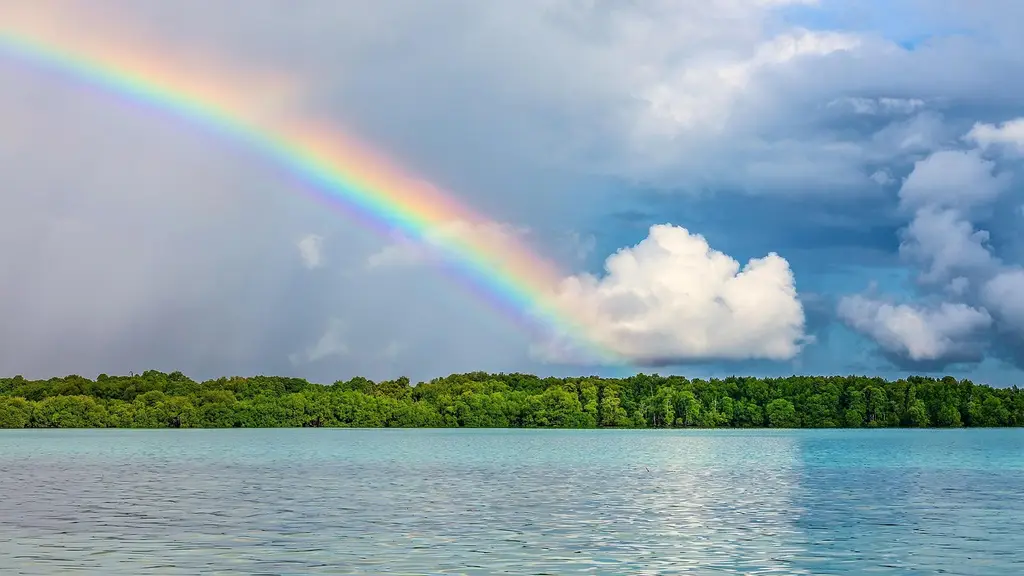
A rainbow can appear in a few seconds and disappear just as fast. One moment the sky is gray and drizzly; the next, a perfect arc of color stretches across it. People have told stories about rainbows for thousands of years. Today, scientists can explain exactly how they are made, and the recipe is surprisingly simple: sunlight, raindrops, and you standing in just the right spot.
This article explains how rainbows form in a way children aged about 7 to 11 can follow with an adult. It also covers some rainbow mysteries, like double rainbows and why you can never reach the end of one, plus a safe way to make your own.
Ingredient 1: Sunlight is made of many colors
Sunlight looks white, but it is really a mixture of every color: red, orange, yellow, green, blue, indigo and violet. Normally these colors travel together, so we see them blended as white light.
To see them separately, something has to split the light up. That is where raindrops come in. If you want to know more about what light is and how it travels, read our guide to what light is.
Ingredient 2: Raindrops bend and bounce light
When a ray of sunlight enters a raindrop, three things happen.
- It bends. Light slows down when it goes from air into water, and that makes it change direction. This bending is called refraction. You can see refraction when a straw in a glass of water looks broken.
- It splits. Each color bends by a slightly different amount. Violet bends the most and red bends the least. So as light enters the drop, the colors start to fan out.
- It bounces and bends again. The light reflects off the back of the raindrop, like a ball bouncing off a wall, and comes back out the front. As it leaves the drop, it bends again, spreading the colors out even more.
Every raindrop does this. Millions of falling drops, each sending out colored light, together make the rainbow you see.
Ingredient 3: You, in the right place
Here is the part many people do not know. To see a rainbow, the Sun must be behind you and the rain must be in front of you.
Light comes out of each raindrop at a special angle, about 42 degrees from the direction the sunlight is traveling. Only drops at exactly that angle from your eyes send their colored light toward you. All those drops together form a circle around a point directly opposite the Sun, at the height of your shadow's head.
That is also why rainbows are most common in the early morning or late afternoon. When the Sun is low, the rainbow circle sits high enough for you to see a big arc. When the Sun is high in the sky at midday, the rainbow would be below the horizon, so you usually cannot see one at all.
Why is red always on top?
In a normal rainbow, red is always on the outside of the arc and violet is on the inside. Red light leaves raindrops at a slightly bigger angle (about 42 degrees) than violet light (about 40 degrees). So the red drops you see are a little higher in the sky than the violet drops. Many people remember the order with the name ROY G. BIV: red, orange, yellow, green, blue, indigo, violet.
Rainbow mysteries solved
Is a rainbow really an arc?
Every rainbow is actually a full circle. From the ground, the bottom half is hidden because there are no raindrops in the right place below the horizon. From an airplane or a high mountain, people sometimes see a complete circular rainbow.
What is a double rainbow?
Sometimes a second, fainter rainbow appears outside the first. This happens when light bounces twice inside each raindrop before coming out. That extra bounce flips the colors, so the second rainbow has red on the inside and violet on the outside. The sky between the two rainbows often looks darker than the rest of the sky.
Can you reach the end of a rainbow?
No! A rainbow is not an object in one place. It depends on where your eyes are compared with the Sun and the raindrops. When you move, the rainbow moves with you. In fact, two people standing side by side each see light from slightly different raindrops, so everyone sees their own rainbow.
Can you see a rainbow at night?
Yes, very rarely. Bright moonlight can make a moonbow. Because moonlight is much dimmer than sunlight, moonbows often look whitish to our eyes, though cameras can capture their colors.
Try this: make your own rainbow
Garden-hose rainbow
You will need: a sunny day, a garden hose with a spray nozzle and an adult.
- Stand with your back to the Sun, in the morning or late afternoon.
- Set the nozzle to a fine mist and spray it in front of you, a little upward.
- Look into the mist and move the spray around until a rainbow appears.
Rainbow on a windowsill
You will need: a clear glass full of water, a sheet of white paper and a sunny window.
- Place the glass of water on a windowsill in bright sunlight, near the edge.
- Put the paper on the floor or a table where light passing through the glass lands.
- Move the paper and glass around until you see a small band of colors.
What's going on? The water in the glass bends the sunlight and splits it into colors, just as raindrops do.
Safety: Never look directly at the Sun while you are looking for rainbows. Use a plastic cup rather than glass if young children are helping, and wipe up spilled water so nobody slips.
The big idea
| Step | What happens |
|---|---|
| 1 | White sunlight enters a raindrop |
| 2 | The light bends and splits into colors |
| 3 | It reflects off the back of the drop |
| 4 | It bends again as it leaves, heading toward your eyes |
| 5 | Millions of drops together make the arc you see |
Questions to talk about together
- Where should you stand to look for a rainbow, and where should the Sun be?
- Why do you think we see rainbows more often after a rain shower in the afternoon than at lunchtime?
- If you and a friend both see a rainbow, are you seeing exactly the same one?
- What other things have you seen that split light into colors? (Think of soap bubbles or the back of a CD.)
- Why is the sky blue on a sunny day, but a rainbow shows every color?
Rainbows connect to lots of other big questions. Find out why the sky is blue, discover how raindrops form in the water cycle, or test your knowledge with the Science Quiz.
Sources and further reading
- Rainbows: optical wonders, Met Office
- Rainbows: Water and Light, U.S. Geological Survey Water Science School
- How Rainbows Are Made, UCAR Center for Science Education