How Solar Panels Turn Light Into Electricity
How silicon solar cells use the photovoltaic effect to turn sunlight into current, why efficiency has limits, and how panels and inverters fit together.
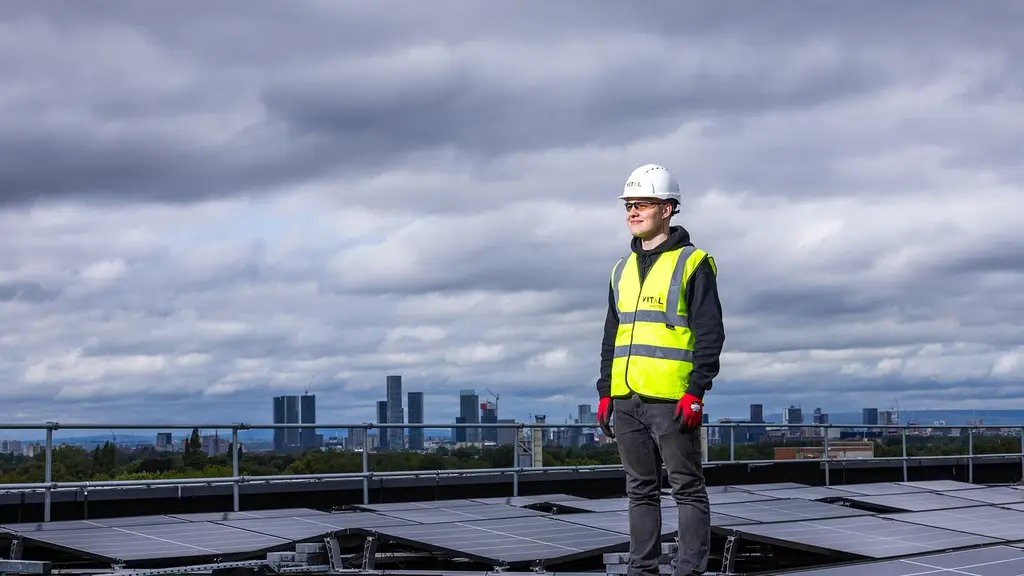
A solar panel sits on a roof, perfectly still and perfectly silent, and makes electricity. There is no fuel, no turbine, no spinning magnet. Light goes in; current comes out. It almost feels like a magic trick, but it is a beautifully clear piece of physics that connects the nature of light, the structure of atoms and some clever materials engineering.
In this article you will learn how a solar cell turns sunlight into electricity, why a typical panel converts only about a fifth of the light that hits it, how the technology was invented, and what happens to the electricity between the roof and your kettle.
Light comes in packets
To understand solar cells, start with light itself. Light behaves both as a wave and as a stream of tiny packets of energy called photons. Each photon carries an amount of energy that depends on its color: blue and ultraviolet photons carry more energy than red and infrared ones. You can read more about this dual nature in What Is Light?.
When a photon hits a material, it can hand its energy to an electron. In most materials, that energy quickly turns into heat. In a solar cell, the material is designed so that the energized electron can be collected and sent around a circuit before it loses its energy. That is the photovoltaic effect: "photo" for light, "voltaic" for electricity, after Alessandro Volta.
Silicon: the workhorse
Almost all solar panels sold today use silicon, the same element found in sand. The U.S. Department of Energy estimates that silicon accounts for roughly 95 percent of solar modules sold.
In a pure silicon crystal, each atom shares its four outer electrons with neighbors in strong bonds. Electrons in these bonds cannot move freely, so pure silicon conducts electricity poorly. But if an electron absorbs enough energy, it can break free and wander through the crystal, leaving behind a gap called a hole that behaves like a positive charge. The minimum energy needed to free an electron is the material's band gap; for silicon it is about 1.1 electron-volts, which matches near-infrared light. For a refresher on atomic structure, see atoms and molecules.
Doping: building in an electric field
Freeing electrons is not enough. If nothing pushes them in one direction, they simply fall back into holes and release their energy as heat. The solution is to build an electric field into the cell, using a process called doping:
- Adding a tiny amount of phosphorus, which has five outer electrons, gives silicon spare electrons. This is n-type silicon (n for negative).
- Adding a tiny amount of boron, which has three outer electrons, creates extra holes. This is p-type silicon (p for positive).
When a layer of n-type silicon sits on top of p-type silicon, some electrons near the boundary drift across to fill holes. This leaves a thin region with a built-in electric field at the p–n junction. That field acts like a one-way slope: free electrons are swept toward the n side and holes toward the p side.
How a solar cell works, step by step
- A photon arrives. Sunlight passes through an anti-reflective coating (which gives cells their dark blue or black color) and into the silicon.
- An electron is freed. If the photon has at least the band-gap energy, it frees an electron, creating an electron–hole pair.
- The junction separates them. The built-in electric field pushes the electron toward the n-type side and the hole toward the p-type side, before they can recombine.
- Charge builds up. Electrons accumulate on the front of the cell; holes on the back. This creates a voltage, about half a volt per silicon cell.
- Current flows. Thin metal fingers on the front and a metal layer on the back collect the charges. When an external circuit connects them, electrons flow through it, doing useful work, and return to the back of the cell to fill holes.
Because a single cell produces only about half a volt, manufacturers wire dozens of cells together in a module (what most people call a panel), and several modules together in an array.
Why not 100 percent efficient?
A typical commercial silicon panel converts roughly 18 to 22 percent of the sunlight striking it into electricity, according to the U.S. Department of Energy. Where does the rest go?
| Loss | What happens |
|---|---|
| Too little energy | Photons with less energy than the band gap pass through or are absorbed as heat without freeing electrons |
| Too much energy | High-energy (blue, ultraviolet) photons free electrons, but the excess energy beyond the band gap is lost as heat |
| Reflection | Some light bounces off the surface despite coatings and texturing |
| Recombination | Some electrons and holes meet and cancel out before being collected |
| Resistance and shading | Metal contacts block some light, and wiring has electrical resistance |
The first two losses are fundamental. In 1961, physicists William Shockley and Hans-Joachim Queisser calculated that a cell made from a single semiconductor junction, under ordinary sunlight, can never convert much more than about a third of sunlight into electricity. Practical silicon cells are approaching that ceiling.
To go further, researchers stack different materials into multi-junction cells, each layer tuned to a different part of the spectrum. Such cells hold the world records for solar cell efficiency, but they are expensive and used mainly in spacecraft and specialized systems. A promising newer approach layers materials called perovskites on top of silicon.
Heat also matters: solar cells become less efficient as they get hotter, so a panel on a cold, bright spring day can outperform the same panel on a scorching summer afternoon.
A short history
- 1839: French physicist Edmond Becquerel, aged 19, observes that light shining on certain materials in a conducting solution produces a small current.
- 1883: American inventor Charles Fritts builds solar cells from selenium coated with a thin layer of gold. They convert only a tiny fraction of light.
- 1905: Albert Einstein explains the related photoelectric effect using the idea of light quanta (photons), work cited in his 1921 Nobel Prize.
- 1954: At Bell Labs, Daryl Chapin, Calvin Fuller and Gerald Pearson announce the first practical silicon solar cell, efficient enough to power small devices.
- 1958: The Vanguard 1 satellite carries small solar cells into orbit, beginning a long partnership between solar power and spaceflight.
- 1970s onward: Energy crises spur research; costs fall steadily over the following decades.
- 2010s–2020s: Large-scale manufacturing makes solar one of the cheapest sources of new electricity in many parts of the world.
From roof to socket
Solar cells produce direct current (DC), which flows in one direction. Homes and the power grid use alternating current (AC), which switches direction many times a second. A device called an inverter converts DC to AC. Some systems use one central inverter; others put a small microinverter on each panel so that a shaded panel does not drag down the rest.
From there, the electricity can:
- power appliances in the building immediately,
- charge a battery for use in the evening (see How Batteries Store Energy),
- or flow out into the grid for neighbors to use.
Large solar farms work the same way at a bigger scale, feeding the grid directly. Solar power's role alongside wind, hydro and other sources is explored in Renewable Energy Explained.
Try this: measure the power of light
With a small solar cell (sold cheaply for hobby kits) and a multimeter set to measure DC volts or milliamps, you can investigate:
- How does output change when you tilt the cell toward or away from the Sun?
- What happens when you cover half the cell with card?
- Does a desk lamp work as well as sunlight? Does color of light matter?
Safety: Never look directly at the Sun, even briefly. Small hobby cells are safe to handle, but children should never touch rooftop panels or their wiring, which can carry dangerous voltages whenever light falls on them.
Key ideas
- Solar cells use the photovoltaic effect: photons free electrons in a semiconductor.
- A p–n junction creates an electric field that separates electrons and holes, driving current.
- Typical silicon panels convert roughly a fifth of sunlight; fundamental physics limits single-junction cells to about a third.
- An inverter converts the panel's DC output into AC for homes and the grid.
Questions to discuss: Why do you think solar panels are angled differently in different parts of the world? What could make a solar panel's output drop on a sunny day? Why might satellites have been one of the first uses for solar cells?
Sources and further reading
- Solar Photovoltaic Cell Basics, U.S. Department of Energy, Solar Energy Technologies Office
- PV Cells 101: A Primer on the Solar Photovoltaic Cell, U.S. Department of Energy
- April 25, 1954: Bell Labs Demonstrates the First Practical Silicon Solar Cell, American Physical Society
- Solar explained, U.S. Energy Information Administration