Newton's Three Laws of Motion in Everyday Life
Seatbelts, shopping carts, skateboards and rockets: see how Newton's three laws of motion explain everyday movement, with worked examples and simple tests.
A bus brakes suddenly and every standing passenger lurches forward. A loaded shopping cart takes a hard shove to get moving, while an empty one practically leaps away from your hand. A balloon, untied and released, zips around the room. These moments look unrelated, but they are all governed by the same three short rules.
Isaac Newton set out those rules in 1687 in his book Philosophiæ Naturalis Principia Mathematica ("Mathematical Principles of Natural Philosophy"), usually just called the Principia. More than three centuries later, engineers still use them to design bridges, cars, roller coasters and spacecraft trajectories.
This guide takes each law in turn, shows where you meet it every day, works through a simple calculation, and suggests quick experiments that let you feel the physics for yourself.
Before Newton: an old idea overturned
For nearly two thousand years, many thinkers followed the view associated with Aristotle that objects naturally come to rest, and that something must keep pushing a moving object to keep it moving. That seems to match experience: stop pedaling a bicycle and it eventually stops.
In the early 1600s, Galileo Galilei challenged this. By rolling balls on smooth ramps and imagining what would happen with less and less friction, he argued that a moving object would keep moving unless something slowed it down. Friction and air resistance, not some natural tendency to rest, are what bring the bicycle to a halt. Newton built on Galileo's insight and turned it into a complete system. (For the wider story, see our article on the Scientific Revolution.)
The first law: things keep doing what they are doing
An object stays at rest, or keeps moving in a straight line at a steady speed, unless an unbalanced force acts on it.
This tendency to resist changes in motion is called inertia. The more mass an object has, the more inertia it has.
The key word is unbalanced. A book resting on a table has forces acting on it: gravity pulls it down and the table pushes it up. Those forces balance, so the book stays put. A car cruising at a steady speed on a flat road also has balanced forces: the push from the engine through the tires matches the drag from air resistance and friction.
Where you meet it:
- Seatbelts and airbags. When a car stops suddenly, your body keeps moving forward at the car's previous speed. The seatbelt supplies the force that slows you down safely along with the car.
- The tablecloth trick. Whip a smooth cloth out quickly enough and the dishes barely move, because the brief friction force is not enough to overcome their inertia.
- Ketchup bottles. Thrust a bottle downward and stop it sharply; the sauce inside keeps going.
- Space probes. Once a spacecraft is far from planets and switches off its engines, it coasts for years with almost no fuel, because nothing is slowing it down.
The second law: force, mass and acceleration
The acceleration of an object depends on the net force acting on it and on its mass.
In equation form, this is the most famous line in mechanics:
Force = mass × acceleration, or F = ma
Acceleration means any change in velocity: speeding up, slowing down or changing direction. The law tells us two things. Push harder on the same object, and it accelerates more. Push equally hard on a heavier object, and it accelerates less.
Force is measured in newtons (N), named in Newton's honor. One newton is the force needed to accelerate a 1-kilogram mass by 1 meter per second, every second. As a rough feel for the size, a small apple of about 100 grams weighs close to one newton on Earth.
A worked example: the shopping cart
Imagine pushing a shopping cart with a steady net force of 30 newtons (ignoring friction to keep things simple).
| Cart | Mass | Acceleration (a = F ÷ m) |
|---|---|---|
| Empty | 15 kg | 30 ÷ 15 = 2 m/s² |
| Half full | 30 kg | 30 ÷ 30 = 1 m/s² |
| Fully loaded | 60 kg | 30 ÷ 60 = 0.5 m/s² |
Each time the mass doubles, the same push produces half the acceleration. That is exactly what your arms tell you in the supermarket.
Where you meet it:
- Sports. A tennis racket delivers a large force to a light ball, giving it a huge acceleration. The same swing would barely budge a bowling ball.
- Trucks and cars. A fully loaded truck needs much more braking force, and a longer distance, to stop than an empty one.
- Weight itself. Your weight is just the second law applied to gravity: your mass multiplied by the acceleration due to gravity, about 9.8 m/s² at Earth's surface. Our guide to gravity explores this further.
The third law: forces come in pairs
When one object pushes or pulls on a second object, the second pushes or pulls back on the first with a force of equal size in the opposite direction.
This is often summed up as "for every action there is an equal and opposite reaction", although that phrasing can mislead. The two forces always act on different objects, which is why they do not cancel each other out.
Where you meet it:
- Walking. Your foot pushes backward on the ground; the ground pushes forward on you. On slippery ice, your foot cannot push back effectively, so you cannot move forward.
- Swimming. Your hands and feet push water backward, and the water pushes you forward.
- Recoil. When you jump off a small boat onto a dock, the boat drifts backward.
- Rockets. A rocket engine forces hot exhaust gases out of its nozzle at high speed; the gases push the rocket forward with an equal force. Rockets do not need air to push against, which is why they work in space. Read more in our guide to how rockets work.
A common puzzle: if a horse pulls a cart and the cart pulls back equally hard, how does anything move? The answer lies in looking at each object separately. The horse moves forward because the ground pushes it forward (in reaction to its hooves pushing back) harder than the cart pulls it back. The cart moves because the horse's pull on it is larger than the friction holding it back. Equal and opposite forces on different objects do not prevent motion.
All three laws at once
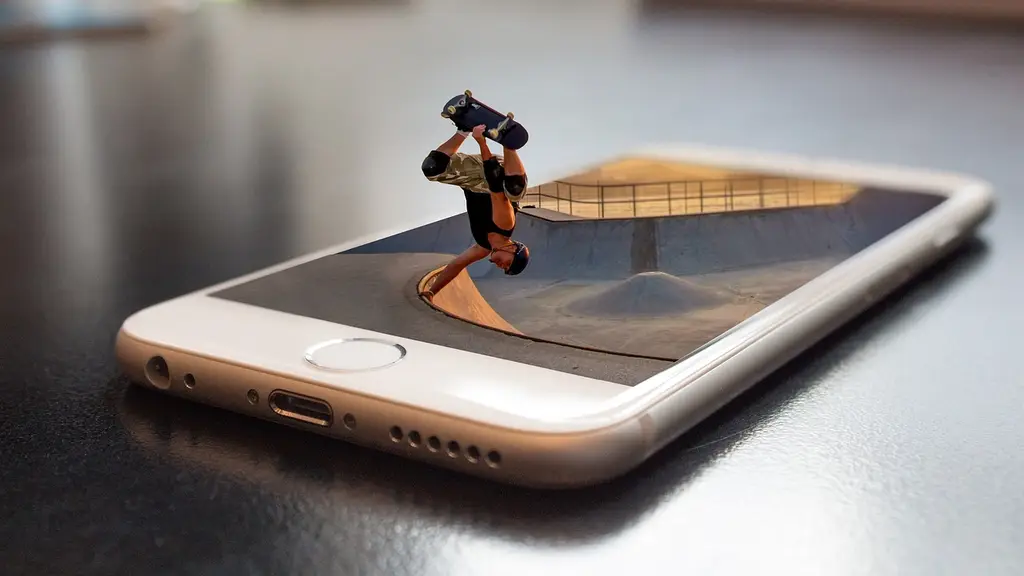
Real situations usually involve all three laws together. Consider a child on a skateboard:
- Standing still, forces balance and the board stays put (first law).
- Pushing off, the child's foot pushes backward on the ground and the ground pushes the child and board forward (third law).
- Speeding up, the size of that forward push and the combined mass of child plus board determine how quickly they accelerate (second law).
- Coasting, friction and air resistance are small unbalanced forces that gradually slow the board (first and second laws).
- Hitting a curb, the board stops abruptly, but the rider's inertia carries them forward (first law), which is why helmets and wrist guards matter.
Try this: feel the laws for yourself
Coin and card (inertia). Place a playing card over the mouth of a glass and put a coin in the middle of the card. Flick the card sharply sideways with a fingertip. The card shoots away, but the coin's inertia keeps it in place until gravity drops it into the glass. A slow push drags the coin along instead. Why?
Balloon rocket (third law). Thread a drinking straw onto a long string and tie the string tight between two chairs. Blow up a balloon, pinch the neck, and tape it to the straw. Let go. Air rushes backward out of the balloon and the balloon races forward along the string. Try a bigger and a smaller balloon and compare.
Toy car ramp (second law). Roll a toy car down a short ramp onto a smooth floor and mark where it stops. Tape a few coins on top to add mass and repeat from the same height. Then try giving the car equal pushes by hand with and without the coins. Record your results in a table.
Safety: Use plastic cups instead of glass with young children. Young children should not blow up balloons unsupervised, and burst balloon pieces are a choking hazard, so collect them straight away. Keep ramps low and test in a clear space.
If you want to experiment without any equipment, the free PhET "Forces and Motion" simulation from the University of Colorado Boulder lets you push crates of different masses and watch the forces in real time.
Where Newton's laws stop working
Newton's laws are extraordinarily successful, but they have limits. For objects moving at a significant fraction of the speed of light, Einstein's special relativity gives the correct answers. For very strong gravity, general relativity takes over. For atoms and electrons, quantum mechanics is needed. In ordinary life, though, from playgrounds to motorways, Newton's version is accurate enough that the differences are far too small to measure.
Quick recap and questions to discuss
- First law: motion does not change unless an unbalanced force acts. Inertia is resistance to change.
- Second law: F = ma. More force means more acceleration; more mass means less.
- Third law: forces come in equal and opposite pairs acting on different objects.
Talk it over: Why is it harder to stop a heavy sledge than a light one moving at the same speed? Which law explains why passengers fall sideways when a car turns sharply? How would a game of football change on a frictionless field? When you're ready, test yourself with our science quiz.
Sources and further reading
- Newton's Laws of Motion, NASA Glenn Research Center
- HyperPhysics: Newton's Laws, Georgia State University, Department of Physics and Astronomy
- Newton's laws of motion, Encyclopaedia Britannica
- Forces and Motion: Basics (interactive simulation), PhET Interactive Simulations, University of Colorado Boulder