The History of the Telescope
From a Dutch spectacle maker's 1608 patent request to Galileo, Newton, Hubble and Webb: how the telescope evolved and what each leap in design revealed.
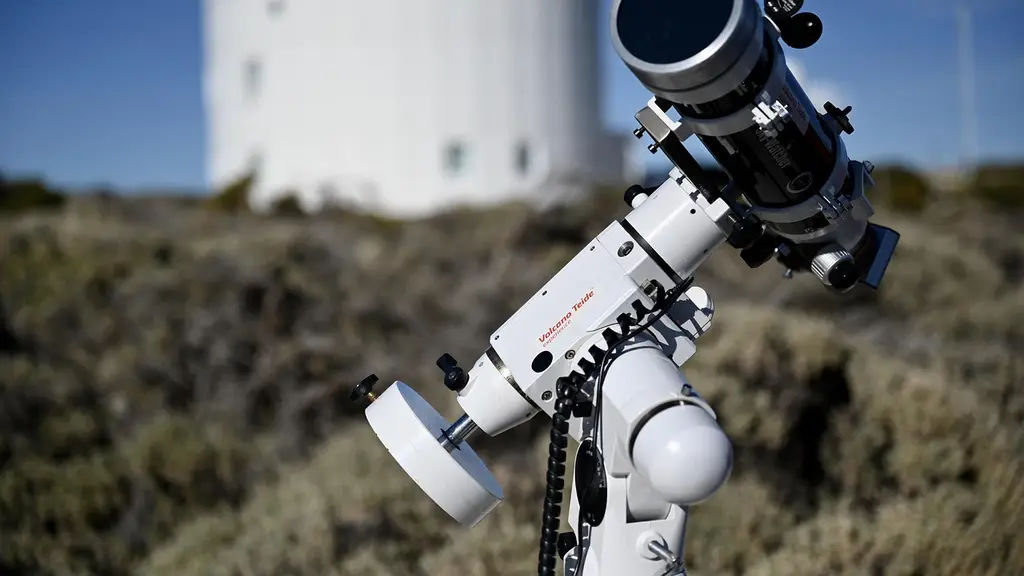
For almost all of human history, astronomy was done with the naked eye. People tracked the planets, predicted eclipses and mapped thousands of stars, but they could not see a single mountain on the Moon or a single moon around another planet. Then, in the first decade of the 1600s, someone put two lenses in a tube, and within a couple of years our picture of the cosmos began to crack open.
This is the story of that instrument: who invented it, how Galileo turned a novelty into a scientific weapon, why Isaac Newton switched from lenses to mirrors, and how today's giant observatories, on mountaintops and in space, continue a 400-year race to collect more light.
The problem every telescope solves
A telescope has two jobs, and magnification is the less important one. Its main job is to gather light. The pupil of your eye is at most about 7 millimeters wide in the dark. A telescope with a lens or mirror 70 millimeters wide collects about 100 times as much light, because light-collecting power depends on area. That lets you see objects far too faint for the unaided eye.
Its second job is resolution: separating fine details, like two stars that sit close together. Larger apertures resolve finer detail, too. So the history of the telescope is largely a history of making the light-collecting part bigger, smoother and more accurate. (For the physics of how lenses bend light, see our guide to what light is.)
Who invented it?
The first documented telescope appears in the Netherlands. In October 1608, Hans Lipperhey, a spectacle maker in Middelburg, asked the Dutch government for a patent on an instrument for seeing distant things as though they were close at hand. Within weeks, other people claimed they had made similar instruments, and the patent was never granted. Spectacle lenses had existed for centuries, so it is likely that more than one craftsman stumbled on the trick of combining a convex and a concave lens. The early instruments magnified only about three times.
Galileo points it at the sky
News of the Dutch invention spread quickly. In 1609 Galileo Galilei, a professor in Padua, heard about it and built his own, grinding his own lenses and steadily improving the design until he reached magnifications of around 20 times. Other people, including the Englishman Thomas Harriot, also turned early telescopes upward, but Galileo observed systematically and published fast.
His short book Sidereus Nuncius ("Starry Messenger"), published in March 1610, reported that:
- the Moon has mountains, valleys and craters, rather than being a perfect smooth sphere;
- the Milky Way is made of countless individual stars;
- Jupiter has four moons circling it, which he first saw in January 1610.
Later that year he observed that Venus shows a full set of phases, like the Moon. That was hard to explain if Venus circled Earth, but natural if it circled the Sun. These discoveries became key evidence in the debate over a Sun-centered universe, a story told in more depth in our article on the Scientific Revolution.
The trouble with lenses
Galileo's design used a convex front lens and a concave eyepiece. In 1611 Johannes Kepler proposed using a convex eyepiece instead, which gave a wider field of view (with an upside-down image, which doesn't matter for stars). Most astronomical refractors since then have followed Kepler's design.
But lenses had a stubborn flaw. A simple glass lens bends different colors by slightly different amounts, so it cannot bring them all to a focus at once. Bright objects appeared fringed with false color. This chromatic aberration could be reduced by making lenses with very long focal lengths, so astronomers in the 17th century built absurdly long telescopes, some with tubes dozens of meters long or no tube at all, the lens hung on a mast. With such instruments Christiaan Huygens discovered Saturn's moon Titan in 1655 and correctly explained Saturn's strange "ears" as a ring.
Newton's mirror
Isaac Newton concluded that color fringing could not be fixed in lenses, and he took a different route. A curved mirror reflects all colors the same way, so it brings them to a single focus. In 1668 he built a small reflecting telescope with a mirror of polished speculum metal and a small flat mirror that bounced the light out to an eyepiece at the side. A later version was shown to the Royal Society in late 1671.
Newton turned out to be wrong that lenses were hopeless. In the 1700s, opticians learned to combine two kinds of glass, such as crown and flint, into an achromatic lens that cancels most of the color error; John Dollond patented one in 1758. Refractors and reflectors then competed for well over a century.
Bigger and bigger
| Year | Telescope | What it showed |
|---|---|---|
| 1781 | William Herschel's homemade reflector | Herschel discovered Uranus, the first planet found with a telescope |
| 1845 | Lord Rosse's "Leviathan," 72-inch reflector, Ireland | Spiral structure in some nebulae, later recognized as galaxies |
| 1897 | Yerkes 40-inch refractor, Wisconsin | The largest refracting telescope used for astronomy, a record it still holds |
| 1917 | Hooker 100-inch reflector, Mount Wilson | Edwin Hubble showed in the 1920s that the Andromeda "nebula" lies far beyond our galaxy |
| 1948 | Hale 200-inch reflector, Palomar | The world's leading large telescope for decades |
| 1993 | Keck I, Hawaii | A 10-meter mirror made of 36 hexagonal segments |
The Yerkes refractor marks a turning point. A lens can only be supported at its edges, so very large ones sag under their own weight. Mirrors can be supported from behind, which is why every large research telescope built since has been a reflector.
Photography, introduced to astronomy in the 19th century, was another revolution. A photographic plate (and later a digital sensor) can collect light for hours, building up images of objects far too faint for any eye. Spectroscopy, which spreads light into its component colors, let astronomers measure what stars are made of and how fast they are moving.
Seeing beyond visible light
In the early 1930s, Karl Jansky, an engineer at Bell Telephone Laboratories, traced a mysterious radio hiss to the center of the Milky Way. That launched radio astronomy and the realization that the universe shines in many kinds of light our eyes can't detect. Today astronomers use radio dishes, infrared and ultraviolet telescopes, and X-ray and gamma-ray observatories. Because Earth's atmosphere blocks much of this radiation, many of these instruments have to work from space.
Space telescopes and new giants
NASA's Hubble Space Telescope was launched on April 24, 1990, with a 2.4-meter mirror. Above the blurring effect of the atmosphere, it should have produced razor-sharp images, but its mirror had been ground to a slightly wrong shape. A Space Shuttle crew installed corrective optics in December 1993, and Hubble went on to become one of the most productive scientific instruments ever built, helping measure the expansion rate of the universe and revealing galaxies billions of light-years away.
The James Webb Space Telescope launched on December 25, 2021. Its 6.5-meter primary mirror is made of 18 gold-coated hexagonal segments that unfolded in space, and it observes mainly in infrared light. That lets it see the stretched light of very early galaxies and study the atmospheres of planets around other stars. It orbits around a point about 1.5 million kilometers from Earth, shaded from the Sun by a tennis-court-sized sunshield.
The next generation on the ground
On the ground, two new facilities show where telescopes are heading. The Vera C. Rubin Observatory in Chile released its first images in June 2025. Its 8.4-meter telescope and 3,200-megapixel camera are designed to photograph the entire southern sky every few nights, making a time-lapse movie of the changing universe. Meanwhile, the European Southern Observatory is building the Extremely Large Telescope, with a 39-meter segmented main mirror; ESO's current schedule plans first light for 2029, with scientific observations to follow.
You can trace these milestones and many more on our interactive Discovery Timeline.
What to take away
The telescope's story is one of steady problem-solving: lenses that blurred colors gave way to mirrors; mirrors that sagged were split into segments; the atmosphere's blur was escaped by going to space. Each step collected more light, and almost every step revealed something nobody expected.
Ideas for further exploration:
- Look at Jupiter through ordinary binoculars held very steady (or resting on a wall). On a clear night you may see up to four tiny points of light beside it, the same moons Galileo saw. Our Solar System Explorer shows where they fit in Jupiter's large family of moons.
- Discuss: why do you think the largest telescopes are built on high, dry mountains far from cities?
- Read about other scientists whose instruments changed what we could know in famous scientists and their discoveries.
Sources and further reading
- Optical telescope, Encyclopaedia Britannica
- Hubble Space Telescope, NASA Science
- James Webb Space Telescope, NASA Science
- The Extremely Large Telescope, European Southern Observatory
- Vera C. Rubin Observatory, NSF–DOE Vera C. Rubin Observatory