Atoms and Molecules: A Beginner's Guide
What are atoms made of, how do they join to form molecules, and just how small are they? A friendly beginner's guide to the building blocks of all matter.
Look at anything around you: this screen, your hand, the air you are breathing, a glass of water. All of it is made of atoms, tiny particles so small that a single drop of water contains more molecules than there are grains of sand on many beaches. Yet from just over a hundred kinds of atom, nature builds everything from diamonds to DNA.
Atoms explain why salt dissolves, why iron rusts, why oxygen keeps us alive and why carbon can form millions of different compounds. Understanding them is the first step into chemistry, and it is easier than many people expect.
This guide explains what atoms are made of, how small they are, how they link together to form molecules and other substances, and how scientists worked all of this out without ever seeing an atom until very recently. There is also a hands-on activity for building molecules at the kitchen table.
An old idea, proved new
The idea that matter is made of tiny, indivisible pieces goes back to ancient Greece. In the 5th century BCE, the philosophers Leucippus and Democritus argued that if you kept cutting something in half, you would eventually reach a piece that could not be cut. They called it atomos, meaning "uncuttable". It was a brilliant guess, but without experiments it remained philosophy.
In the early 1800s, the English chemist John Dalton turned atoms into science. He proposed that each element is made of its own kind of atom, with its own characteristic weight, and that chemical reactions rearrange atoms without creating or destroying them. Dalton's theory explained why elements always combine in fixed proportions.
Over the following century, experiments showed that atoms are not uncuttable after all. J. J. Thomson discovered the electron in 1897. Ernest Rutherford's team showed in 1911 that atoms have a tiny, dense nucleus. James Chadwick discovered the neutron in 1932. For the full story, see our article From Dalton to Bohr: The Changing Picture of the Atom.
Inside an atom
Every atom has two main parts: a nucleus at the center and electrons around it.
| Particle | Where it is found | Electric charge | Relative mass |
|---|---|---|---|
| Proton | In the nucleus | Positive (+1) | 1 |
| Neutron | In the nucleus | None (0) | About 1 |
| Electron | Around the nucleus | Negative (−1) | About 1/1836 of a proton |
A few key ideas follow from this table:
- Almost all of an atom's mass is in its nucleus. Protons and neutrons are each nearly two thousand times heavier than an electron.
- Atoms are mostly empty space. The nucleus is tens of thousands of times smaller across than the whole atom. If an atom were blown up to the size of a sports stadium, the nucleus would be roughly the size of a pea in the center, with electrons spread through the surrounding space.
- Electrons are not tiny planets. Older diagrams show electrons circling like planets, but modern physics describes them as clouds of probability, called orbitals, showing where an electron is likely to be found. Electrons are arranged in levels or shells, and the outermost electrons control how an atom bonds with others.
- A neutral atom has equal numbers of protons and electrons, so their charges balance.
What makes one element different from another
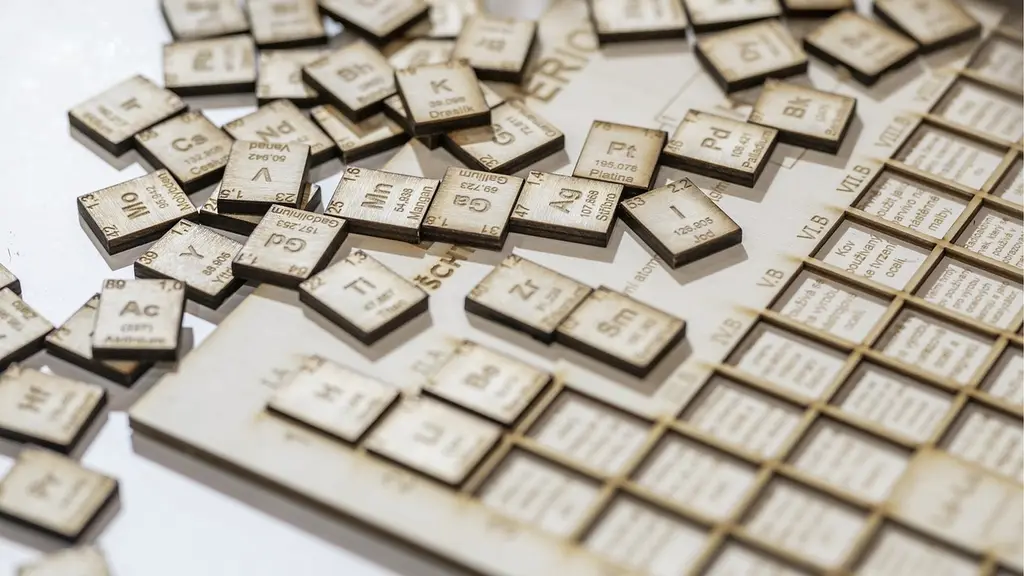
The number of protons in an atom's nucleus is its atomic number, and it defines which element the atom is. One proton means hydrogen; six means carbon; eight means oxygen; 79 means gold. The periodic table lists all 118 known elements in order of atomic number, and you can explore each one in our interactive periodic table.
Atoms of the same element can have different numbers of neutrons. These variants are called isotopes. Most carbon atoms have six neutrons (carbon-12), but a small fraction have seven (carbon-13) or eight (carbon-14). Carbon-14 is radioactive and slowly decays, which is what makes radiocarbon dating possible.
If an atom gains or loses electrons, it becomes electrically charged and is called an ion. Losing electrons makes a positive ion; gaining them makes a negative ion.
Just how small?
Atoms are typically around 0.1 to 0.5 nanometers across, where a nanometer is a billionth of a meter. Several hundred thousand carbon atoms lined up side by side would barely span the width of a human hair.
Because atoms are so small, chemists count them in enormous batches called moles. One mole contains exactly 602,214,076,000,000,000,000,000 particles (6.02214076 × 10²³), a number known as the Avogadro constant. Since 2019, this value has been fixed exactly as part of the International System of Units. One mole of water molecules weighs about 18 grams, little more than a tablespoon. So a single small drop of water, about one-twentieth of a milliliter, contains roughly 1.7 × 10²¹ water molecules: almost two thousand billion billion.
For centuries, no one could see individual atoms. That changed with the scanning tunneling microscope, invented in the early 1980s by Gerd Binnig and Heinrich Rohrer at IBM in Zurich. It maps surfaces atom by atom using a needle-sharp tip, and earned its inventors a share of the 1986 Nobel Prize in Physics.
From atoms to molecules
Atoms rarely stay alone. Most join with other atoms by forming chemical bonds, driven largely by the arrangement of their outer electrons. The noble gases, such as helium and neon, are the exception: their outer shells are already full, so they are content to drift around as single atoms.
A molecule is a group of two or more atoms held together by bonds. Some molecules contain only one element: the oxygen we breathe is mostly O₂, two oxygen atoms bonded together. Others, called compounds, contain different elements.
| Molecule | Formula | Atoms it contains | Where you meet it |
|---|---|---|---|
| Oxygen | O₂ | 2 oxygen | The air we breathe |
| Water | H₂O | 2 hydrogen, 1 oxygen | Everywhere |
| Carbon dioxide | CO₂ | 1 carbon, 2 oxygen | Breath, fizzy drinks |
| Methane | CH₄ | 1 carbon, 4 hydrogen | Natural gas |
| Glucose | C₆H₁₂O₆ | 6 carbon, 12 hydrogen, 6 oxygen | Sugar made by plants |
A chemical formula is a compact recipe: the letters are element symbols, and the small numbers say how many of each atom are present.
Three ways atoms hold together
- Covalent bonds. Atoms share pairs of electrons. This is the usual bond between nonmetal atoms and holds together water, carbon dioxide, sugar and the long chains of polymers such as plastics.
- Ionic bonds. One atom gives electrons to another, creating oppositely charged ions that attract. Table salt, sodium chloride, is a classic example. Strictly speaking, salt is not made of separate molecules at all, but of a vast, repeating lattice of sodium and chloride ions.
- Metallic bonds. In metals, outer electrons are shared across the whole structure in a mobile "sea", which is why metals conduct electricity and can be bent and hammered without shattering.
Shape matters
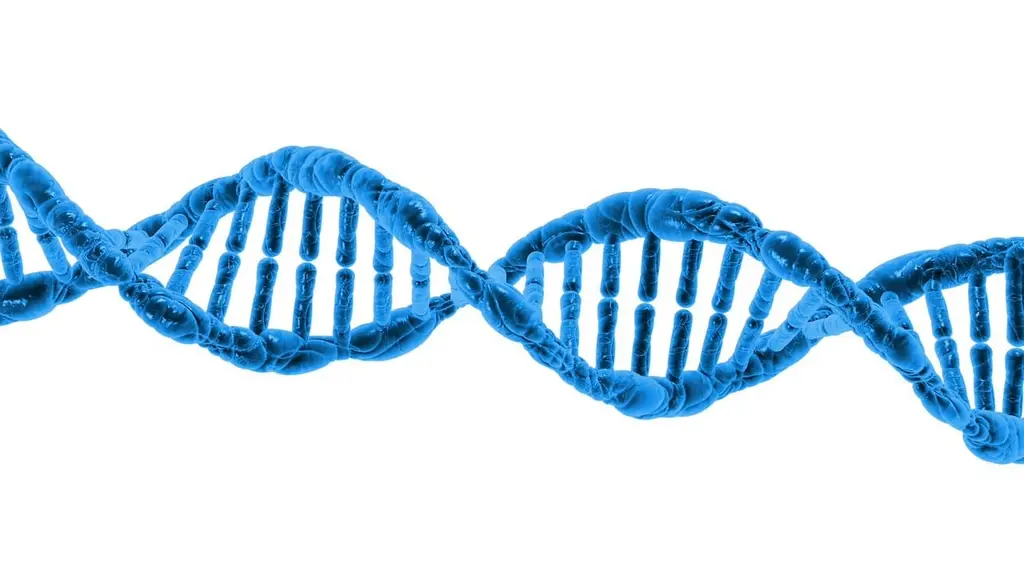
Molecules have definite three-dimensional shapes, and shape affects behavior. A water molecule is bent, with an angle of about 104.5 degrees between its two hydrogen atoms. That bend, along with oxygen's strong pull on electrons, gives water a slightly negative end and a slightly positive end. Those charges let water molecules cling to each other and dissolve many substances, properties that make water essential for life. Shape matters in biology too: the twisted ladder of DNA, described in The Discovery of DNA's Double Helix, is a giant molecule whose shape is the key to how it stores information.
Try this: build edible molecules
You will need: mini marshmallows or gumdrops in at least three colors, or balls of modeling clay, and toothpicks or uncooked spaghetti.
- Choose a color for each element: for example, white for hydrogen, red for oxygen and black or dark green for carbon.
- Use sticks as bonds. Build a water molecule (H₂O): one oxygen with two hydrogens. Try to bend it, rather than making it straight.
- Build carbon dioxide (CO₂). Carbon forms two double bonds here, so use two sticks between carbon and each oxygen. This molecule is straight.
- Build methane (CH₄): one carbon with four hydrogens. Can you arrange the hydrogens so they are as far apart as possible? (The answer is a pyramid shape called a tetrahedron, not a flat cross.)
- Challenge: build glucose, or invent a molecule and look it up to see if it exists.
Safety: Marshmallows and gumdrops are a choking hazard for young children, and toothpicks are sharp, so use modeling clay and spaghetti with under-fives and supervise closely. Don't eat candy that has been handled by lots of people.
A second quick demonstration: Drop a little food coloring into a glass of cold water and another into a glass of hot water (adult to handle the hot water). The coloring spreads faster in the hot water, because its molecules are moving faster and jostle the dye around more vigorously. It is indirect evidence that molecules are real and always in motion. To see how that motion explains melting and boiling, read Solids, Liquids, Gases and Plasma.
Key ideas
- Atoms are made of protons and neutrons in a tiny nucleus, with electrons around it.
- The number of protons (the atomic number) decides which element an atom is.
- Atoms bond by sharing electrons (covalent), transferring them (ionic) or pooling them (metallic).
- Molecules are groups of bonded atoms; their composition and shape determine how substances behave.
Questions to talk about: If atoms are mostly empty space, why can't you walk through a wall? Why might carbon, with four outer electrons available for bonding, be so good at forming the complex molecules of life? What would you need to change to turn one element into another?
Sources and further reading
- Atom, Encyclopaedia Britannica
- Avogadro constant (CODATA value), NIST Physical Measurement Laboratory
- Periodic Table of Elements, International Union of Pure and Applied Chemistry (IUPAC)
- The Nobel Prize in Physics 1986, The Nobel Prize
- Periodic Table, Royal Society of Chemistry