How Computers Evolved
From the abacus and Babbage's engines to vacuum tubes, transistors, microchips and smartphones: the key ideas and machines behind the computer in your pocket.
The phone in your pocket can perform billions of calculations every second. In the 1940s, a machine with a tiny fraction of that power filled a large room, weighed about as much as several elephants and needed a team of people to keep it running. Before that, a "computer" was not a machine at all. It was a job title for a person, often a woman, who did calculations by hand.
The story of how we got from beads on wires to pocket supercomputers is not a single invention but a chain of ideas, each building on the last: mechanical calculation, programmability, electronics, the stored program, the transistor and the integrated circuit. This article walks through those turning points and explains why each one mattered.
Counting with hands and gears
People have used tools to help with arithmetic for thousands of years. The abacus, with beads sliding on rods, was used across the ancient world and is still used today. In the seventeenth century, inventors began building mechanical calculators. Blaise Pascal built a gear-driven adding machine in 1642, and Gottfried Wilhelm Leibniz designed one that could also multiply.
These devices could carry out a single arithmetic operation when a person turned the handles. They could not follow a sequence of instructions on their own. That idea, programmability, came from an unexpected place: weaving.
Punched cards and Babbage's engines
In 1804, Joseph-Marie Jacquard introduced a loom controlled by chains of punched cards. Holes in each card determined which threads were lifted, so changing the cards changed the pattern. It was, in effect, a program for cloth.
In Britain, the mathematician Charles Babbage was frustrated by errors in printed mathematical tables, which were calculated by hand. In 1822 he proposed a Difference Engine to calculate and print tables automatically. He later conceived something far more ambitious: the Analytical Engine, a general-purpose machine with a "mill" (a processor), a "store" (memory) and instructions fed in on punched cards, borrowing Jacquard's idea.
The mathematician Ada Lovelace studied the Analytical Engine closely. In notes published in 1843, she described how it could calculate a sequence called the Bernoulli numbers, often cited as one of the first published computer programs, and suggested such a machine might one day manipulate symbols such as musical notes, not just numbers. Babbage never finished either engine in his lifetime. In 1991, London's Science Museum completed a working Difference Engine No. 2 from his designs, showing that the plans were sound. Lovelace is one of the people featured in our article on women who changed science.
Punched cards found practical use in 1890, when Herman Hollerith's electric tabulating machines processed the U.S. Census far faster than hand counting. His company eventually became part of IBM.
A theory of computing
In 1936, the British mathematician Alan Turing published a paper describing an imaginary device, now called a Turing machine, that reads and writes symbols on a tape according to simple rules. He showed that such a machine could, in principle, carry out any calculation that can be described as a step-by-step procedure. This gave computing a mathematical foundation and the idea of a universal machine that could be reprogrammed for any task.
Thinking in clear, ordered steps is something children can practice without any device at all; see computational thinking without a screen.
War and the first electronic machines
World War II accelerated computing dramatically, as governments needed to calculate artillery tables and break enemy codes.
- In Germany, Konrad Zuse completed the Z3 in 1941, an electromechanical, program-controlled calculator built with telephone relays.
- In Britain, engineers led by Tommy Flowers built Colossus in 1943–44 at Bletchley Park to help break high-level German teleprinter codes. It used vacuum tubes (valves) and was kept secret for decades. Codebreaking's role in computing history is explored in our archive article on codes and ciphers.
- In the United States, John Mauchly and J. Presper Eckert built ENIAC at the University of Pennsylvania. Unveiled in February 1946, it used around 18,000 vacuum tubes and could perform thousands of additions per second. It was reprogrammed by rewiring cables and setting switches, a job carried out largely by a team of women programmers.
Vacuum tubes could switch on and off thousands of times faster than mechanical relays, but they ran hot, used lots of power and burned out regularly.
The stored-program idea
Reprogramming by rewiring was slow. The breakthrough was to store the program in the computer's memory alongside the data, so changing the task meant loading new instructions rather than moving cables. This stored-program design is often associated with a 1945 report by John von Neumann, drawing on discussions with the ENIAC team.
On 21 June 1948, the Manchester "Baby" (the Small-Scale Experimental Machine) at the University of Manchester ran the first program stored in electronic memory. EDSAC at the University of Cambridge followed in 1949 and was soon providing a regular computing service to scientists. Virtually every computer since has used the stored-program principle.
Transistors and microchips
In December 1947, John Bardeen, Walter Brattain and William Shockley at Bell Labs demonstrated the transistor, a tiny semiconductor device that could amplify and switch electrical signals. It was smaller, more reliable and far more efficient than a vacuum tube. The three shared the 1956 Nobel Prize in Physics.
The next leap was to stop wiring individual components together. In 1958, Jack Kilby at Texas Instruments built the first integrated circuit, with several components formed on a single piece of semiconductor. In 1959, Robert Noyce at Fairchild Semiconductor developed a version made on flat silicon that was much easier to mass-produce.
In 1965, Gordon Moore observed that the number of components on a chip was doubling at a regular pace, a trend later described as roughly every two years. "Moore's law" was an observation rather than a law of nature, but it held for decades and drove the astonishing shrinking and cheapening of computers.
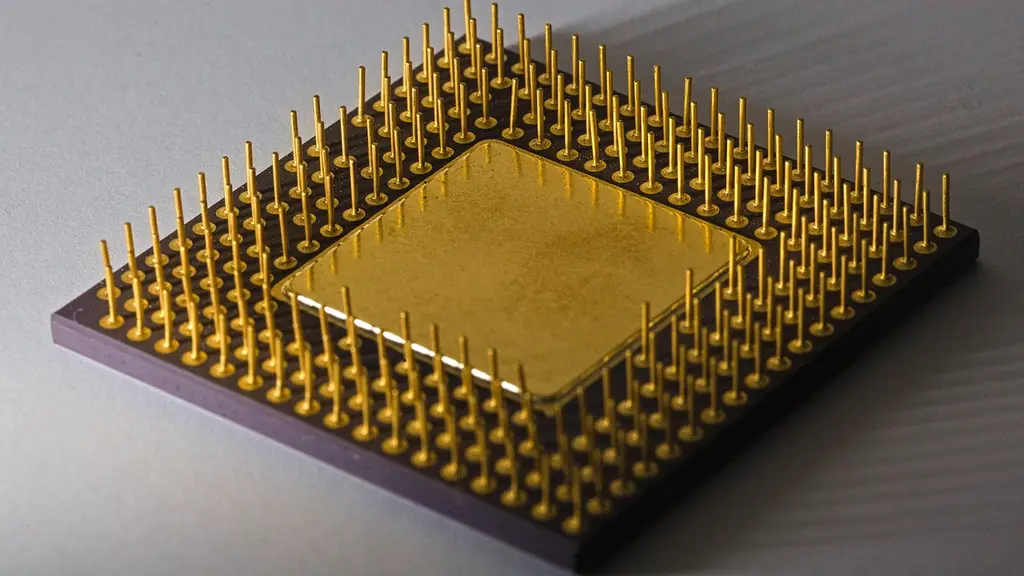
In 1971, Intel released the 4004, a microprocessor that put an entire central processing unit on one chip with about 2,300 transistors. Modern processors contain billions.
Computers for everyone
Once processors fit on a chip, computers could become personal.
| Year | Milestone | Why it mattered |
|---|---|---|
| 1973 | Xerox Alto | Research computer with a mouse, windows and icons |
| 1975 | Altair 8800 | Kit computer that sparked the hobbyist boom |
| 1977 | Apple II, Commodore PET, TRS-80 | Ready-made home computers |
| 1981 | IBM Personal Computer | Set a widely copied business standard |
| 1984 | Apple Macintosh | Brought the graphical interface to a mass market |
| 1991 | World Wide Web made public | Computers became windows onto shared information |
| 2007 | iPhone and the modern smartphone era | A powerful networked computer in a pocket |
Each step put computing into more hands and found new uses: word processing, spreadsheets, games, email, music, photography, navigation. Today, computers are embedded in cars, washing machines and medical devices, often invisibly. Connecting them all together is a story in itself, told in How the Internet Works.
Five ideas that made modern computing
Looking back, a handful of concepts carry the whole story:
- Programmability: a machine that follows changeable instructions (Jacquard, Babbage, Lovelace).
- Universality: one machine can, in principle, perform any computable task (Turing).
- Electronic switching: signals controlled by electricity, not moving parts (vacuum tubes, then transistors).
- The stored program: instructions kept in memory like data (Manchester Baby, EDSAC).
- Integration and miniaturization: many components on one chip, getting smaller and cheaper (integrated circuits, Moore's law).
Questions to explore
- Why do you think early computers were built for war and government before homes?
- What jobs did human "computers" do before electronic machines, and what happened to those jobs?
- If transistors keep shrinking, what physical limits might engineers eventually run into?
To place these milestones alongside other breakthroughs, try our interactive discovery timeline.
Sources and further reading
- Revolution: The First 2000 Years of Computing, Computer History Museum
- Timeline of Computer History, Computer History Museum
- Computer: History of computing, Encyclopaedia Britannica
- ENIAC, Encyclopaedia Britannica
- National Museum of American History, Smithsonian Institution