How Rockets Work
Why rockets don't need air to push against, how thrust, staging and orbital speed work, and the history that took rockets from fire arrows to reusable boosters.
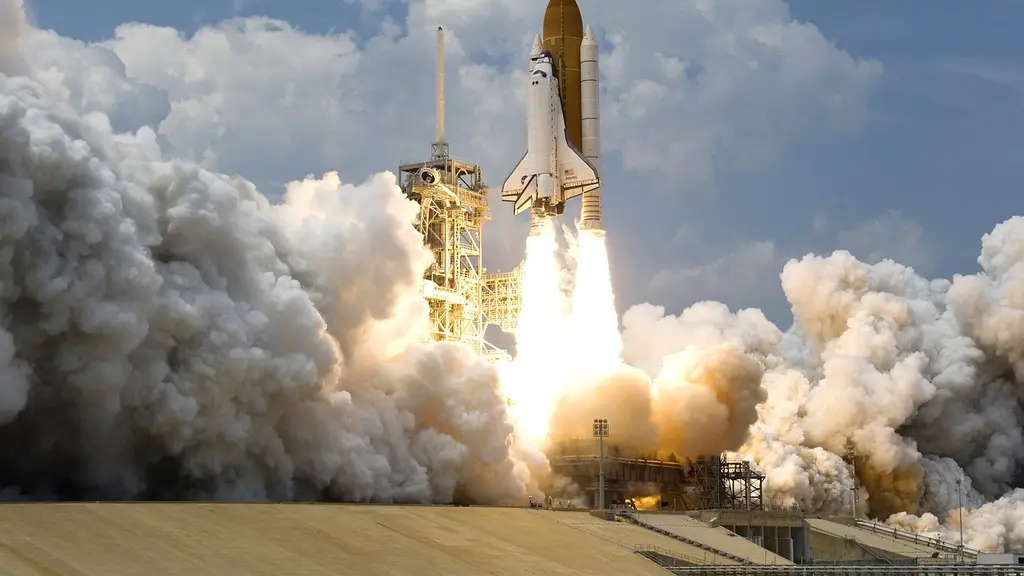
Blow up a balloon, pinch the neck, then let go. It zips around the room in a wild, spluttering spiral until it runs out of air. That silly moment contains nearly all the physics of a rocket launch. A rocket is, at heart, a very carefully controlled balloon: it throws material out of one end as fast as possible, and it is pushed the other way in return.
In this article you'll find out why rockets work perfectly well in the vacuum of space, why getting into orbit is about going sideways fast rather than simply going up, why most rockets drop pieces of themselves on the way, and how a century of experiments took us from gunpowder tubes to boosters that land themselves.
Action and reaction
The key idea is Isaac Newton's third law of motion: when one object pushes on another, the second pushes back with an equal force in the opposite direction. (If you want a refresher, our guide to Newton's three laws of motion covers all three with everyday examples.)
Inside a rocket engine, propellants burn in a combustion chamber and produce an enormous volume of hot gas at very high pressure. That gas rushes out through a nozzle at the back. The engine pushes the gas backward; the gas pushes the engine, and the whole rocket, forward. That forward push is called thrust.
A very common misconception is that the exhaust "pushes against the air" or against the ground. It does not. The push happens inside the engine, between the rocket and its own exhaust. In fact, rocket engines work slightly better in a vacuum, where there is no surrounding air pressure pushing back on the exhaust.
This point once caused a famous public mistake. In 1920 a New York Times editorial mocked the physicist Robert Goddard for suggesting a rocket could work in space, claiming it would have nothing to push against. The newspaper published a correction in July 1969, as Apollo 11 was on its way to the Moon.
What a rocket carries: fuel and oxidizer
Burning needs two ingredients: a fuel and an oxidizer, something that supplies oxygen or plays the same chemical role. A car engine takes its oxygen from the air. A rocket can't rely on that, because the air thins out and then disappears, so it carries its own oxidizer. That is the main difference between a rocket and a jet engine.
| Type | How it works | Strengths | Examples of use |
|---|---|---|---|
| Solid propellant | Fuel and oxidizer are mixed into a rubbery solid that burns from the inside | Simple, storable, very high thrust | Fireworks, model rockets, strap-on boosters |
| Liquid propellant | Fuel and oxidizer are stored in separate tanks and pumped into the engine | Can be throttled, shut down and sometimes restarted | Most main-stage engines (kerosene, liquid hydrogen or methane with liquid oxygen) |
| Electric (ion) | Electricity accelerates charged atoms to very high speed | Extremely efficient over long periods | Steering satellites, deep-space probes |
Ion engines produce a push so gentle it would barely move a sheet of paper on Earth, so they can't lift anything off the ground. But in space, firing steadily for months, they can build up large changes in speed using very little propellant.
The chemistry in a launch engine is not so different from a burning candle or the reactions described in chemical reactions in the kitchen: fuel combines with oxygen and releases energy. The difference is the rate, the temperature and the careful engineering needed to aim all that energy out of one end.
Why orbit is about going sideways
Getting "to space" in the sense of reaching about 100 kilometers of altitude is surprisingly achievable; suborbital rockets do it and fall straight back down. Staying in space is much harder, and the reason is speed, not height.
Newton described the idea with a thought experiment. Imagine a cannon on a very tall mountain firing a ball horizontally. A slow ball curves down and hits the ground nearby. A faster ball lands farther away. Fire it fast enough and the ground curves away beneath it as fast as it falls, so it never lands. It keeps falling around the Earth forever. That is an orbit.
For a spacecraft in low Earth orbit, a few hundred kilometers up, that speed is about 7.8 kilometers per second, or roughly 28,000 kilometers per hour. The International Space Station travels at that pace and circles the planet about every 90 minutes. Astronauts float not because gravity has vanished (at that height it is still about 90 percent as strong as on the ground) but because they and their station are falling together.
To escape Earth's gravity entirely and head for the Moon or another planet, a spacecraft needs to reach about 11.2 kilometers per second. That is why a rocket climbs vertically for only a short time after launch and then tips over to fly increasingly sideways: most of its effort goes into building horizontal speed.
The tyranny of the rocket equation
In 1903 the Russian schoolteacher Konstantin Tsiolkovsky published the mathematics that still governs every launch. His rocket equation links three things: how fast the exhaust leaves the engine, how much of the rocket's starting mass is propellant, and the total change in speed the rocket can achieve.
The uncomfortable conclusion is that speed gets expensive very quickly. To go a bit faster you need more propellant, but that extra propellant is itself heavy and must be accelerated too, which needs still more propellant. As a result, most of a large rocket's launch mass is propellant, and only a small fraction ends up as useful payload in orbit.
Engineers fight back in two main ways. First, they chase higher exhaust speeds through better propellants and engine designs. Second, they use staging.
Staging: dropping dead weight
Once a tank is empty, it is just dead weight. A multistage rocket stacks several rockets on top of each other. The first stage lifts everything off the ground; when its propellant runs out, it separates and falls away, and the next stage's engines ignite. Each stage only has to push what remains above it.
The Saturn V that carried astronauts to the Moon used three stages. Its first stage, powered by five F-1 engines, produced about 7.5 million pounds of thrust at liftoff and burned for under three minutes before separating.
Try this: a string-and-balloon rocket.
- Thread a long piece of string through a drinking straw and tie the string tightly between two chairs across a room.
- Blow up a long balloon and pinch the neck closed (a clothes peg helps).
- Tape the balloon to the straw with the neck pointing toward one chair.
- Let go and watch the balloon race along the string.
- Experiment: does a fuller balloon go farther? What happens if you tape two balloons in a line, releasing the back one first, to model staging?
Adults should supervise younger children, and keep burst balloon pieces away from toddlers, as latex fragments are a choking hazard.
From fire arrows to reusable boosters
Rockets have a long history, and they were weapons long before they were vehicles.
- 13th century: Chinese forces used gunpowder "fire arrows," often dated to the defense of Kaifeng against Mongol armies in 1232.
- 1903: Tsiolkovsky publishes the rocket equation and argues that liquid propellants could reach space.
- 1926: On March 16, Robert Goddard launches the first liquid-fueled rocket from a farm in Auburn, Massachusetts. It flew for about 2.5 seconds and climbed around 12 meters.
- 1957: The Soviet Union launches Sputnik 1 on October 4, the first artificial satellite.
- 1961: Yuri Gagarin becomes the first human to orbit Earth.
- 1969: A Saturn V launches Apollo 11, and humans walk on the Moon.
- 2015: SpaceX lands the first stage of a Falcon 9 rocket back on land after an orbital launch, beginning a new era of reusable boosters.
Reusability matters because the rocket itself has traditionally been thrown away after a single flight. Recovering and refurbishing boosters can lower the cost of each launch, much as reusing an airliner is cheaper than building a new one for every trip.
Steering in space
Once a rocket is moving, it needs to be guided. Main engines often swivel on gimbals to tilt their thrust and steer the vehicle, rather like steering a shopping cart by pushing one corner. In space, small thrusters fire in short bursts to turn a spacecraft or adjust its orbit. Because there is no air resistance, a spacecraft coasting with its engines off keeps moving at constant speed, exactly as Newton's first law predicts.
Spacecraft heading to other planets rarely fly in straight lines. Mission planners pick paths that follow the curve of orbits around the Sun, and they sometimes swing past a planet to borrow some of its orbital energy in a "gravity assist." You can see how far apart those destinations are with our Solar System Explorer, and read about the planets themselves in the solar system explained.
The big ideas in a nutshell
- Rockets work by throwing exhaust backward; the exhaust pushes the rocket forward (Newton's third law). They do not need air to push against.
- Rockets carry both fuel and oxidizer, which is why they work beyond the atmosphere.
- Orbit means moving sideways fast enough, about 7.8 km/s near Earth, to keep falling around the planet.
- The rocket equation makes extra speed costly, so engineers use efficient engines and multiple stages.
- Reusable boosters are changing the economics of spaceflight.
Questions to explore together: Why do astronauts float on the space station even though gravity is still strong there? If you had to design a rocket for a planet with stronger gravity than Earth, what would you change? And for a deeper look at the forces involved, browse our physics articles.
Sources and further reading
- Beginner's Guide to Rockets, NASA Glenn Research Center
- Newton's Laws of Motion, NASA Glenn Research Center
- Robert Goddard, Encyclopaedia Britannica
- Rocket: jet-propulsion device and vehicle, Encyclopaedia Britannica