How the Periodic Table Works
Why is the periodic table shaped the way it is? Learn how rows, columns and blocks reveal how elements behave, and how Mendeleev used gaps to predict new ones.
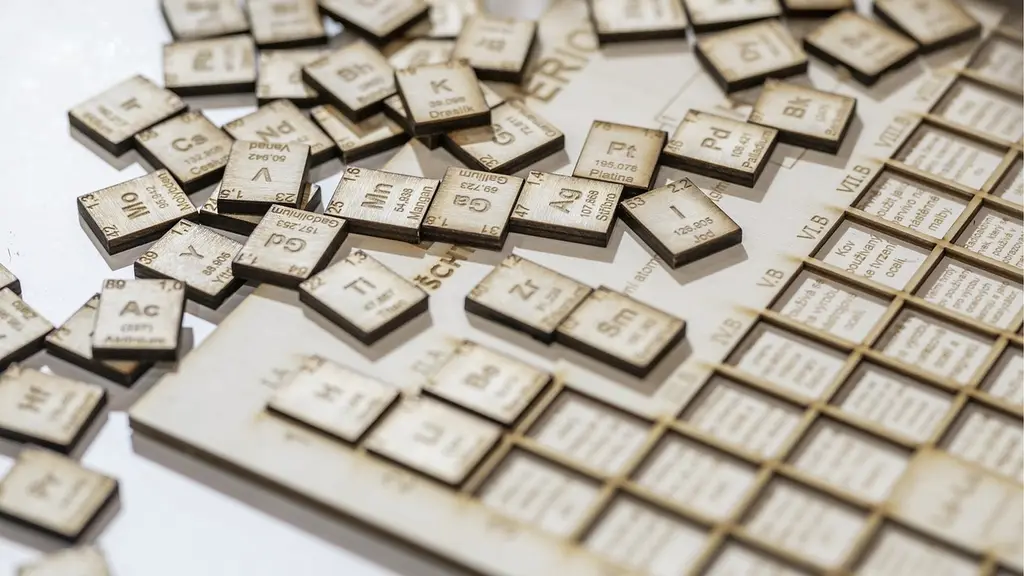
Hanging on the wall of almost every chemistry classroom is a chart that looks, at first glance, like a strangely shaped grid of letters. It is easy to see it as something to memorize. In fact, the periodic table is closer to a map, and once you can read it, it tells you a remarkable amount about how each element behaves, often before you have even met it.
Why does sodium explode in water while neon refuses to react with anything? Why do copper, silver and gold all make good coins? Why is the table such an odd shape, with a tall column on each side and a strip floating underneath? All of these answers are built into the layout.
This guide explains how the table is organized, what its rows, columns and blocks mean, how it was discovered, and how to use it to make predictions. Keep our interactive periodic table open in another tab as you read.
What is an element?
An element is a substance made of only one kind of atom. Every atom has a tiny, dense nucleus containing positively charged protons (and, usually, neutral neutrons), surrounded by negatively charged electrons.
What makes an element itself is the number of protons in each atom, called its atomic number. Every hydrogen atom has one proton; every carbon atom has six; every gold atom has 79. Change the number of protons and you have a different element. (If you need a refresher on the parts of an atom, see Atoms and Molecules: A Beginner's Guide.)
There are 118 known elements. About 90 occur naturally on Earth; the rest have been made in laboratories, often only a few atoms at a time. The most recent additions, nihonium (113), moscovium (115), tennessine (117) and oganesson (118), received their official names from the International Union of Pure and Applied Chemistry (IUPAC) in November 2016, completing the seventh row.
Reading the grid
The elements are arranged in order of increasing atomic number, reading left to right and top to bottom, like the words on a page. But the lines "wrap" at particular points, so that elements with similar properties end up stacked in the same column.
Rows: periods
The seven horizontal rows are called periods. Moving along a period, each element has one more proton and one more electron than the one before. The period number tells you how many shells (energy levels) of electrons the atom has in its ground state. Hydrogen and helium, in period 1, have one shell; potassium, in period 4, has four.
Columns: groups
The 18 vertical columns are called groups, numbered 1 to 18. Elements in the same group have the same number of electrons in their outermost shell, called valence electrons, and those outer electrons largely control how an atom reacts. That is why elements in the same column behave like members of a family.
| Group | Family name | Typical behavior | Examples |
|---|---|---|---|
| 1 | Alkali metals | Soft, very reactive metals; react with water to make hydrogen and an alkaline solution | Lithium, sodium, potassium |
| 2 | Alkaline earth metals | Reactive, but less so than group 1 | Magnesium, calcium |
| 3–12 | Transition metals | Hard, shiny, good conductors; often form colorful compounds | Iron, copper, silver, gold |
| 17 | Halogens | Very reactive nonmetals; form salts with metals | Fluorine, chlorine, iodine |
| 18 | Noble gases | Very unreactive gases | Helium, neon, argon |
Hydrogen sits at the top of group 1 because it has one electron, but it is a gas with properties all its own, and some chemists argue it does not truly belong to any group.
Blocks: the reason for the shape
The table's odd shape comes from the way electrons fill different types of orbitals (regions where electrons are likely to be found), labeled s, p, d and f.
- The s-block is the two tall columns on the left (groups 1 and 2), plus helium.
- The p-block is the six columns on the right (groups 13 to 18).
- The d-block is the ten columns in the middle: the transition metals.
- The f-block is the two rows usually shown floating beneath the main table: the lanthanides and actinides. They really belong inside periods 6 and 7, but printing them in place would make the table awkwardly wide, so they are tucked underneath.
Patterns across the table
Because the layout follows electron arrangements, many properties change in predictable ways. These patterns are called periodic trends.
- Metals and nonmetals. Roughly three-quarters of the elements are metals, filling the left and center. Nonmetals cluster at the upper right. Along the staircase-shaped boundary between them sit the metalloids, such as silicon and germanium, with in-between properties that make them useful in electronics.
- Atomic size. Atoms generally get smaller from left to right across a period, because the growing positive charge of the nucleus pulls the electrons in more tightly. They get larger down a group, as extra shells of electrons are added.
- Reactivity. In group 1, reactivity increases down the column: lithium fizzes in water, sodium skates around and may ignite, and potassium bursts into flame. The outer electron is farther from the nucleus in larger atoms and is given away more easily. Among the halogens, the trend runs the other way: fluorine is the most reactive.
- Electronegativity, an atom's pull on shared electrons in a bond, generally increases toward the upper right of the table (ignoring the noble gases). Fluorine has the highest value of all.
These trends let chemists predict how an unfamiliar element will behave from its position alone. They also explain why the noble gases are so aloof: their outer shells are full, so they have little tendency to gain, lose or share electrons.
How the table was discovered
By the mid-1800s, chemists knew of about 60 elements and had noticed families with similar properties. Several scientists proposed ways to arrange them. The arrangement that became famous was presented in 1869 by the Russian chemist Dmitri Mendeleev.
Mendeleev ordered the elements by atomic weight and grouped them by their chemical behavior. His boldest move was to leave gaps where no known element fitted, and to predict that elements would be discovered to fill them. He even forecast their properties. Below aluminum, for example, he predicted an element he called "eka-aluminum".
In 1875 the French chemist Paul-Émile Lecoq de Boisbaudran discovered a new metal, gallium, using spectroscopy. Its properties matched Mendeleev's eka-aluminum strikingly well. The later discoveries of scandium and germanium, which also fitted predicted gaps, convinced many chemists that the periodic table reflected something real about nature.
A few elements still seemed to be out of order by weight. The puzzle was solved in 1913 and 1914, when the English physicist Henry Moseley used X-rays to show that each element has a characteristic atomic number, and that ordering by atomic number, not weight, gives the correct sequence. The noble gases, discovered in the 1890s, were slotted in as a whole new column. In 2019, the 150th anniversary of Mendeleev's table was celebrated as the International Year of the Periodic Table. For the wider story of how scientists came to understand atoms, read From Dalton to Bohr.
Using the table to make predictions
Here is a quick way to practice reading the table like a chemist. Pick an element you have never studied, say, rubidium (atomic number 37), and ask:
- Which group is it in? Group 1, with the alkali metals.
- What does that suggest? One outer electron, which it gives away easily, so it should be a soft, reactive metal.
- Where is it within the group? Below potassium, so it should be even more reactive than potassium.
- What compounds might it form? Like sodium chloride (table salt), it should combine with chlorine to make a salt, rubidium chloride.
All of those predictions are correct. Rubidium is so reactive that it can ignite spontaneously in air and is stored under oil or in sealed glass ampoules.
Try this: build your own periodic table
Element card sort. Write about 20 of the first 36 elements on index cards, adding a few facts to each: atomic number, whether it is a metal or nonmetal, whether it is a solid, liquid or gas at room temperature, and how reactive it is (look these up on our periodic table explorer). Shuffle the cards and ask children to arrange them in a way that makes sense. Then reveal the real table and compare. Did they discover any of the same families?
This mirrors what Mendeleev himself did, and it works well with groups. Leaving a few cards out lets students "predict" missing elements, just as he did.
Safety: Do not attempt to obtain or handle reactive elements such as sodium, potassium or iodine at home. Demonstrations with alkali metals must be done only by trained teachers with proper safety equipment.
Key ideas to remember
- Elements are defined by their atomic number, the number of protons in each atom.
- The table runs in order of atomic number; rows (periods) show electron shells, and columns (groups) gather elements with the same number of outer electrons and similar behavior.
- The table's shape reflects how electrons fill s, p, d and f orbitals.
- Mendeleev's 1869 table was powerful because it predicted elements no one had yet found.
Colorful flame tests, which reveal some elements by the light they give off, are one more way the table connects to everyday life; you can read about them in The Chemistry of Colour. For more articles like this, explore our chemistry section.
Sources and further reading
- Periodic Table of Elements, International Union of Pure and Applied Chemistry (IUPAC)
- IUPAC Announces the Names of the Elements 113, 115, 117, and 118, IUPAC
- Periodic Table, Royal Society of Chemistry
- Periodic Table of the Elements, National Institute of Standards and Technology
- Periodic table, Encyclopaedia Britannica