From the archive
Why GPS Needs Atomic Clocks: From Rabi's Atomic Beams to Satellite Navigation
How 1930s atomic-beam physics, Ramsey's clock method and Einstein's relativity combined to make GPS work, and why satellite clocks are corrected by 38 µs a day.
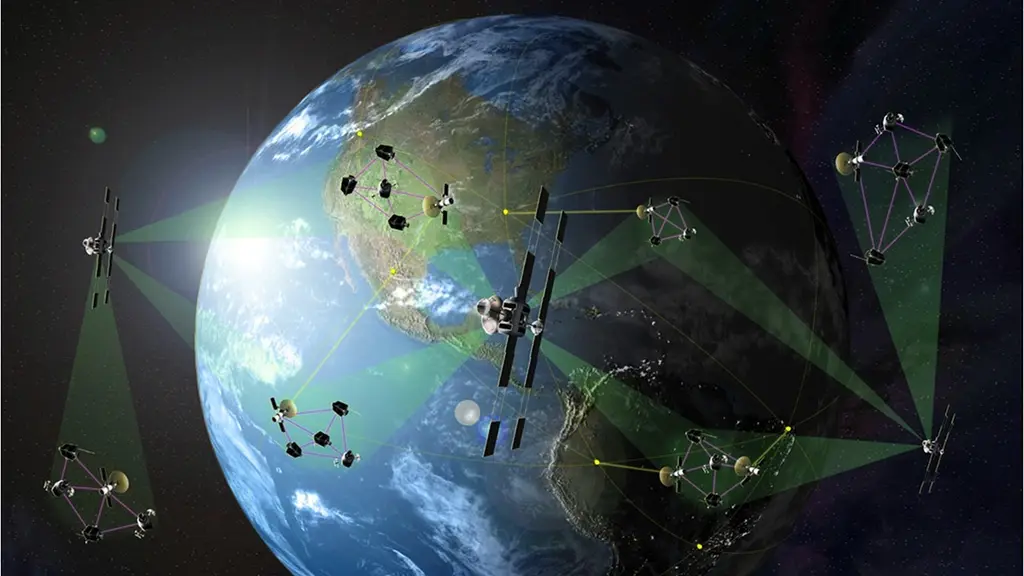
Tap the map on a phone and a blue dot appears, usually within a few meters of where you are standing. It feels like the phone simply knows. In fact it is doing something closer to listening: picking up faint radio whispers from satellites about 20,000 kilometers overhead and timing them with extraordinary care.
The surprising part of the story is where that ability came from. Nobody set out in the 1930s to build a navigation system. Physicists were trying to measure the magnetic personalities of atomic nuclei, and later to test a strange prediction of Einstein's that clocks tick at different rates depending on gravity and speed. Those curiosity-driven experiments produced the atomic clock, and the atomic clock is the beating heart of GPS.
This article explains how GPS turns time into position, how atomic clocks were invented, and why engineers have to correct satellite clocks for relativity every single day.
Position is really a timing problem
Every GPS satellite broadcasts a continuous message that amounts to: "This is satellite number such-and-such, here is exactly where I am, and here is exactly what time it was when I sent this." A receiver on the ground notes when each message arrives. Because radio waves travel at the speed of light, the delay tells the receiver how far away the satellite is.
That sounds simple until you put numbers on it. Light covers roughly 30 centimeters in a billionth of a second (a nanosecond). A clock error of just one microsecond, a millionth of a second, turns into a distance error of about 300 meters. To place you on the right street, the timing has to be good to a few tens of nanoseconds.
A phone cannot carry a clock that good, so GPS uses a clever trick. Distance to one satellite places you somewhere on a huge imaginary sphere. A second satellite narrows that to a circle, a third to a couple of points. The receiver then treats its own clock error as a fourth unknown, alongside latitude, longitude and altitude. With signals from four satellites it can solve for all four at once. In effect, every GPS receiver borrows the accuracy of the atomic clocks in orbit.
| Timing error | Approximate distance error |
|---|---|
| 1 nanosecond | 0.3 meters |
| 10 nanoseconds | 3 meters |
| 1 microsecond | 300 meters |
| 1 millisecond | 300 kilometers |
Quick check: GPS satellites orbit at about 20,200 km. A signal from a satellite straight overhead takes about 20,200 ÷ 300,000 ≈ 0.067 seconds to arrive, roughly one-fifteenth of a second. The receiver needs to measure that delay to within a few hundred-millionths of a second.
Atoms that keep perfect time
An ordinary clock counts the swings of something that oscillates: a pendulum, a balance wheel, a vibrating quartz crystal. The trouble is that real pendulums and crystals are all slightly different, and they drift with temperature and age. Atoms do not have that problem. Every cesium-133 atom in the universe is identical, and each one absorbs microwave radiation at exactly the same frequency when its outermost electron flips its magnetic orientation relative to the nucleus.
The first person to measure such atomic frequencies precisely was the physicist Isidor Isaac Rabi at Columbia University. In the late 1930s Rabi sent beams of atoms or molecules through carefully shaped magnetic fields and hit them with radio waves. When the radio frequency matched a natural frequency of the nuclei, the particles flipped and were deflected out of the beam. Rabi's goal was pure physics: learning about the magnetic properties of atomic nuclei. His "resonance method" earned him the 1944 Nobel Prize in Physics, and the same idea, magnetic resonance, later grew into the MRI scanner, a story told in our archive article on the physics behind MRI.
From a lab technique to a clock
Rabi realized that his resonance frequencies were so stable they could serve as the "pendulum" of a clock, and he publicly suggested the idea in the mid-1940s. One motivation was scientific: such a clock might be precise enough to test Einstein's prediction that time runs at different rates in different gravitational fields.
Turning the idea into hardware took several further steps:
- 1949: At Harvard, Norman Ramsey, a former student of Rabi's, invented the separated oscillatory fields method. Instead of exposing atoms to radio waves along one long stretch, he used two short bursts separated by a gap. The result was a much sharper, more precise resonance. Ramsey's method became the basis of cesium atomic clocks, and he shared the 1989 Nobel Prize in Physics for it.
- 1949: The U.S. National Bureau of Standards (now NIST) demonstrated an early atomic clock based on ammonia molecules.
- 1955: Louis Essen and Jack Parry at Britain's National Physical Laboratory ran the first cesium-beam clock accurate enough to serve as a time standard.
- Mid-1950s: MIT physicist Jerrold Zacharias worked with industry to shrink the cesium clock into a commercial instrument, which made atomic timekeeping available outside a handful of laboratories.
- 1967: The international definition of the second was changed. Since then, one second has been defined as 9,192,631,770 cycles of the radiation from that cesium-133 transition. Time itself is now an atomic measurement.
None of these researchers was thinking about satellites. They were improving a measurement because better measurements open up new questions.
Einstein in orbit: the daily relativity correction
Einstein's theories predict two competing effects on a clock carried by a satellite.
- Speed slows it down. Special relativity says a moving clock runs slow compared with one at rest. GPS satellites travel at nearly 4 kilometers per second, so their clocks lose about 7 microseconds per day relative to clocks on the ground.
- Weaker gravity speeds it up. General relativity says clocks run faster where gravity is weaker. Twenty thousand kilometers up, that effect makes satellite clocks gain about 45 microseconds per day.
The net result is that a GPS satellite clock runs fast by roughly 38 microseconds per day. Physicist Neil Ashby's detailed review of relativity in GPS gives the figure as about 38.6 microseconds. That sounds tiny, but recall the table above: 38 microseconds of light travel is more than 11 kilometers. If nobody corrected for relativity, position fixes would be useless within a day.
The fix is built in before launch. The clocks' reference frequency is supposed to be 10.23 MHz, but engineers set them to tick very slightly slower, about 10.22999999543 MHz, so that once in orbit they appear to run at the correct rate when seen from Earth. Receivers also apply small extra corrections, because satellite orbits are not perfect circles. GPS is often called the most everyday proof that Einstein was right.
From tracking Sputnik to a global utility
Satellite navigation also has roots in an unexpected observation. When the Soviet Union launched Sputnik in October 1957, William Guier and George Weiffenbach at the Johns Hopkins University Applied Physics Laboratory listened to its radio beeps and noticed that the pitch shifted as it passed overhead, the Doppler effect. By analyzing the shift, they could work out the satellite's orbit. Colleagues soon flipped the problem around: if you know where a satellite is, the Doppler shift can tell you where you are. That became the U.S. Navy's Transit system, built for submarines in the 1960s and later opened to civilian ships.
Transit gave a fix only every so often and worked best for slow-moving vessels. In 1973, U.S. defense planners settled on a design for something better: a constellation of satellites, each carrying atomic clocks and broadcasting precise time, so that users anywhere could get continuous three-dimensional positions. The first test satellite was launched in 1978. The system reached its planned 24-satellite strength in 1993, and full operational capability was declared in 1995.
For its first years, GPS deliberately degraded the signal available to civilians, a feature called Selective Availability. In 1996 the U.S. government announced a plan to end it, and on May 1, 2000 it was switched off, improving civilian accuracy overnight from roughly a hundred meters to a few meters. That decision is a big reason GPS is now inside phones, cars, farm machinery and fitness watches.
GPS today
According to GPS.gov, the satellites orbit in medium Earth orbit at about 20,200 kilometers, circling the planet twice a day in six orbital planes. The baseline design needs 24 satellites so that at least four are visible from almost anywhere on Earth, and the U.S. Space Force normally keeps more than that in service; recent official counts put the operational constellation at 31 or more satellites. Newer satellites broadcast additional civilian signals that make positioning more accurate and robust.
Navigation is only half of what GPS delivers. Because every satellite carries atomic time, GPS receivers are also used to synchronize mobile phone networks, power grids and financial systems. Many people who never look at a map rely on GPS timing every day.
Europe's Galileo, Russia's GLONASS and China's BeiDou work on the same principle, and modern receivers often combine them. Meanwhile clock research has kept going. Laboratory optical clocks, which use atoms that oscillate at visible-light frequencies, are now far more precise than cesium clocks, and metrologists are discussing a future redefinition of the second. Today's experiments in timekeeping, like Rabi's, are aimed at fundamental physics, and may one day become part of everyday technology.
Key ideas to take away
- GPS finds your position by timing radio signals; one microsecond of error means about 300 meters.
- A receiver needs four satellites because its own clock error is a fourth unknown.
- Atomic clocks grew out of Rabi's 1930s resonance experiments and Ramsey's 1949 improvement, research done to understand atoms, not to navigate.
- Relativity makes satellite clocks run fast by about 38 microseconds a day, so they are deliberately tuned slow before launch.
Questions to discuss: Why can't a phone simply carry its own atomic clock? What would happen to GPS if engineers had ignored Einstein? Can you think of another everyday technology that depends on very precise timing? For more on the physics, see our explainers on gravity, from falling apples to black holes and how rockets reach orbit, or explore the discovery timeline.
Sources and further reading
- GPS: The Global Positioning System, U.S. government (GPS.gov)
- Relativity in the Global Positioning System (Ashby, Living Reviews in Relativity, 2003), Living Reviews in Relativity / PubMed Central
- The Nobel Prize in Physics 1944: Isidor Isaac Rabi, Nobel Prize Outreach
- The Nobel Prize in Physics 1989, Nobel Prize Outreach
- SI base unit: second, Bureau International des Poids et Mesures (BIPM)
- Original Beyond Discovery article (PDF), National Academy of Sciences, 1997 (archived at brucealberts.org)