Science at Home for Homeschooling Families
A practical guide to homeschool science: planning a year, a sample weekly rhythm, a starter kit, mixed-age lessons, safety, record keeping and free resources.
Homeschooling families have an advantage that most classrooms would envy: time. A question asked at breakfast can turn into an experiment by lunch. A rainy afternoon can become a lesson on clouds. A walk can become a survey of every insect on one bush. The flip side is that without a timetable, science can slide to the bottom of the list, squeezed out by reading and math.
This guide is for parents who want science at home to be regular, rigorous and enjoyable without buying an expensive kit for every topic. It covers how to plan a year, what a typical week might look like, the equipment worth having, how to teach several ages at once, how to keep records, and where to find reliable free materials.
Start with a plan, not a pile of activities
Activity ideas are easy to find. What many families lack is a sequence, so that ideas build on each other. A simple way to plan is to divide the year into four or five broad themes and rotate them over a few years.
| Theme | Example topics (younger) | Example topics (older) |
|---|---|---|
| Living things | Life cycles, plants, habitats | Cells, ecosystems, genetics |
| Materials and matter | Sorting materials, melting and freezing | Atoms, chemical reactions, the periodic table |
| Forces and energy | Push and pull, magnets, simple machines | Newton's laws, electricity, energy transfer |
| Earth and space | Weather, seasons, the Moon | Rocks and plate tectonics, the solar system |
| Human body | Senses, teeth, healthy eating | Body systems, immunity, the brain |
If you want a reference for what children typically learn at each age, the US Next Generation Science Standards and England's national curriculum for science are both freely available online. You don't need to follow either, but they are useful for checking coverage and for avoiding big gaps if your child may later join a school.
A realistic weekly rhythm
Science does not need to happen every day. Many families find that two or three sessions a week, each 30 to 60 minutes, plus informal science woven through daily life, works well. Here is one possible pattern:
- Monday: Read and wonder (30 minutes). Read a nonfiction book or article on the week's topic. Children write or draw three things they learned and one question. Our list of educational science books is a good source.
- Wednesday: Hands-on investigation (45–60 minutes). An experiment, model or field observation linked to the topic.
- Friday: Record and explain (30 minutes). Children write up or draw what happened, explain it to a family member, or record a short video "science report".
- Anytime: Nature and everyday science. Weather observations, cooking, gardening, stargazing, fixing things.
Imagine a family studying states of matter over one week. On Monday they read about solids, liquids and gases. On Wednesday they freeze water in different-shaped containers, time how long ice cubes take to melt in different places around the house, and watch steam condense on a cold lid. On Friday the older child writes up a results table while the younger one draws "before and after" pictures. The topic has been covered with depth and no expensive equipment.
A starter science kit
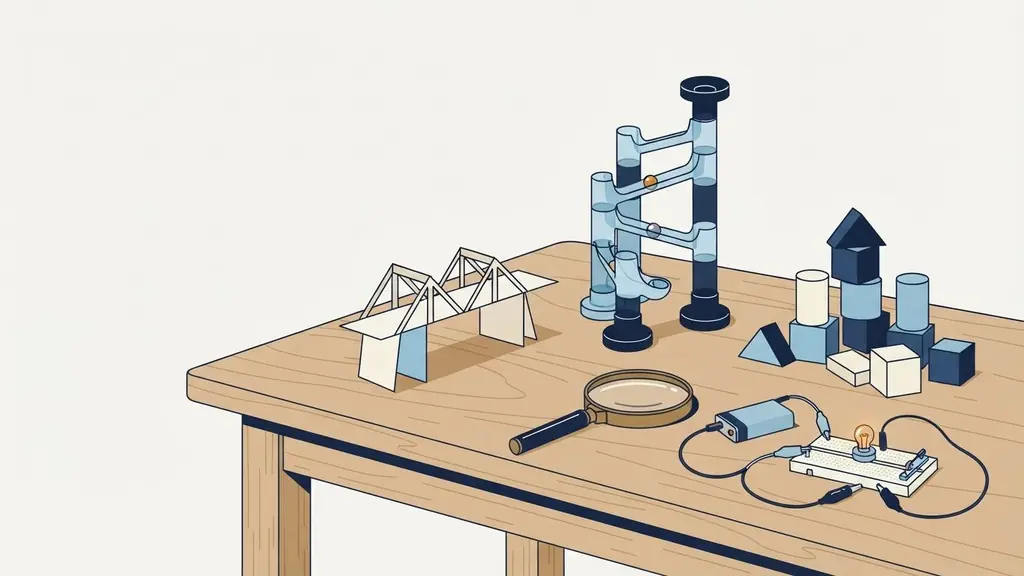
You can do a remarkable amount of science with household items. Over time, it is worth collecting the following in one box so that experiments are easy to start:
- Measuring tools: kitchen scales, measuring jugs and spoons, a ruler and tape measure, a timer, a basic thermometer.
- Observation tools: a magnifying glass or hand lens, a cheap pair of binoculars, a notebook for each child.
- Containers: clear plastic cups, jars with lids, ice cube trays, plastic pipettes or droppers.
- Consumables: baking soda, vinegar, food coloring, salt, sugar, cornstarch, red cabbage (for an indicator), balloons, straws, aluminum foil, paper towels, tape.
- Physics extras: bar magnets, a set of small springs or rubber bands, toy cars, marbles (keep away from under-fours).
- For older children: safety goggles, a simple circuit kit with AA battery holders, bulbs and wires, and a basic microscope if budget allows.
Our collection of kitchen chemistry experiments uses almost nothing beyond this list.
Safety at home: Store chemicals in their original labeled containers, never in food or drink bottles. Never mix household cleaning products, as some combinations release toxic gases. Keep button batteries, small magnets and small balls away from young children; swallowed magnets and button batteries can cause serious internal injuries. Use goggles whenever liquids could splash, and supervise any activity involving heat, sharp tools or glass. Our guide to safe science experiments for children covers the basics in more detail.
Teaching several ages at once
Most homeschooling families have children of different ages, and teaching separate science lessons to each can be exhausting. A practical solution is to teach one shared topic with different expectations.
Shared core. Everyone reads the same book, watches the same demonstration or goes on the same walk.
Differentiated tasks. Then each child works at their level:
- A five-year-old might sort leaves by shape and color and dictate a sentence about them.
- A nine-year-old might measure leaves, record length and width in a table, and use a simple key to identify trees.
- A thirteen-year-old might calculate leaf area, compare sun and shade leaves, and write a short explanation linked to photosynthesis.
Older siblings can also act as "lab assistants" for younger ones. Explaining something to a younger child is one of the best ways for an older one to find gaps in their own understanding.
Using the world as your lab
Homeschoolers can take science out of the house far more easily than schools can.
- Museums and science centers. Many offer homeschool days or term passes. Plan a visit around a theme rather than trying to see everything.
- Gardens and parks. Grow something every year, even if it is just herbs on a windowsill. Track growth, weather and pollinator visits.
- The night sky. Our Solar System Explorer helps children learn what they are looking at before going outside on a clear night.
- Citizen science. Projects such as iNaturalist, where you photograph and identify wildlife, and the online Zooniverse platform, where volunteers classify real research data, let children contribute to genuine science.
- Outdoor seasons. Our guide to outdoor science lessons in any season has ideas for every month.
Keeping records
Records matter, both because some jurisdictions require evidence of learning and because a portfolio lets children see how far they have come. Keep it simple:
- A science notebook per child. Dated entries with drawings, tables, photos and questions. Encourage messy, genuine records over neat copying.
- A photo log. Photograph experiments and outings, and add a one-line caption saying what was learned.
- A topic checklist. Tick off themes as you cover them so gaps are obvious at a glance.
- Periodic reviews. Every few weeks, ask children to explain a past topic in their own words, or try a short self-check. Our periodic table tool makes a quick review game for older children studying chemistry.
Check your local legal requirements, as record-keeping rules for home education vary between countries, states and regions.
When you feel out of your depth
Many parents worry about teaching subjects they struggled with at school. A few reassurances:
- You do not need to know the answer. "Let's find out" is the most scientific sentence there is.
- Learning alongside your child models curiosity and persistence.
- For topics that need expertise, reputable organizations such as NASA publish free lessons and videos designed for educators, and many universities and museums run online talks.
- As children get older, consider local co-ops, online courses or a tutor for subjects like chemistry and physics that need specialist equipment.
Next steps
Choose one theme for the next six weeks, set two fixed science slots in your weekly timetable, and assemble a starter box from the list above. Start small, keep a notebook, and let your children's questions steer some of the journey. Science at home works best when it feels less like a lesson and more like a family habit of noticing, wondering and testing.
Sources and further reading
- Next Generation Science Standards, Achieve / NGSS Lead States
- National curriculum in England: science programmes of study, UK Department for Education
- NASA STEM Learning Resources, NASA
- iNaturalist, California Academy of Sciences and National Geographic Society
- Zooniverse: People-Powered Research, Zooniverse